Best Gray Cards of 2026

A gray card is one of those buys you make after a shoot goes wrong: the white shirt in the lobby portrait that came out the color of weak tea, or the product shot that looked fine on your screen and green on your client's. What you're actually buying is a known reference — an 18% neutral surface you photograph once so your editing software knows what neutral looks like.

The catch is that "18%" and "neutral" get printed on plenty of cards that are neither, and the difference only shows up in the edit. We've spent four months shooting, folding, pocketing, and re-shooting 14 of them, from wallet-sized cards to 12-inch foldable panels.

Size is where most people guess wrong: a big card is easier to fill a frame with in a portrait or product setup, but a small one actually travels. Material is the other fork — rigid PVC versus fabric stretched over a wire frame that folds down and springs back open. The picks below split along both lines.

Keeper Score summarizes customer ratings and review volume. Read it alongside the product details and trade-offs. How the score works.

1

Best Overall

Lightdow 12x12 Foldable Gray Card

95 /100
Keeper Score Outstanding

Key details

Open Size
12 x 12 in (30 x 30 cm)
Folded Size
5.1 x 5.1 x 0.8 in
Gray Reflectance
17.8%
Exposure Accuracy
1/8 f-stop max error
Check Price on Amazon

The fold is the whole argument. A 12-inch target that collapses into a 5-inch square and 76 grams of nylon is one you actually carry, and carrying it is the difference between white balancing on location and meaning to. The gray side is rated at 17.8% reflectance with a stated maximum error of an eighth of a stop, tight enough that in ordinary light you will not see a gap between a reading off the card and what your meter wanted.

Both faces earn their keep. The gray takes an exposure reading or a balance reference you carry into editing, and the white reverse sets a custom balance in camera when you are shooting video or JPEG and want it right on set. The wire frame is stiff, which is what keeps the panel flat instead of sagging, and it is also why the first few folds take a deliberate two-handed twist. After that it is a five-second job, and the panel goes back into a zippered pouch rather than a sleeve.

What it will not do is lie flat. Set it on a table for copy work and the frame holds the face a few degrees off the surface, which is fine for metering a room and wrong for copying a print. That is the trade for the size, and it is one we make happily on a location day and never on a copy stand.

Pros

  • Folds to a 5-inch square at 76 g
  • 12-inch face fills the frame from a few feet back
  • Stated 1/8-stop maximum exposure error
  • White reverse side for in-camera balance

Cons

  • Frame keeps the face off a flat surface
  • Only 90 days of warranty coverage
Our verdict

We reach for this one because it opens big enough to meter from a few feet away and folds small enough to live in the bag, which is the balance most photographers need.

Check Latest Price
2

Best for Color-Critical Work

WhiBal G7 Pocket Card

88 /100
Keeper Score Excellent

Key details

Weight
1 oz
Card Size
2.1 x 3.35 in
Thickness
0.040 in
Neutrality
a* and b* within 0.5
Check Price on Amazon

The priciest card in this group asks you to pay for one thing: a number. Every card is individually measured, and the specification claims a* and b* values within 0.5 of perfect neutral, a tolerance the budget cards here never state at all. At 2.1 by 3.35 inches it is a wallet card, 0.040 inch thick, and it wipes clean after a day in a pocket.

Certification sounds like marketing right up to the point where a card is not neutral. A gray that is slightly off does not announce itself; it tilts every frame you correct with it, and you find out in the edit with a whole card of images in front of you. That is why this one lives in the wallet slot and the inexpensive cards get treated as exposure tools first.

The size is the other half of the decision. This is a card for close work: a portrait at arm's length, a product on a table, a wall you can walk up to. For a wide interior or a full-length frame you need a bigger face, which is why ours travels next to a 12-inch panel rather than instead of one. Get this one on its own only if your work is close and repeatable.

Pros

  • Individually measured to within 0.5 on a* and b*
  • Thin, rigid, and resistant to scratches and water
  • Wallet sized, so it is always with you

Cons

  • Premium price for a wallet-sized card
Our verdict

If the color has to be right the first time, this is the card we trust, and the premium buys a measured neutral rather than a hoped-for one.

Check Latest Price
3

Best Rigid Card Set

JJC 8x10 PVC Card Set

84 /100
Keeper Score Excellent

Key details

Storage
Zippered bag
Material
PVC
Card Size
8 x 10 in each
Set Contents
Gray, white, black cards
Check Price on Amazon

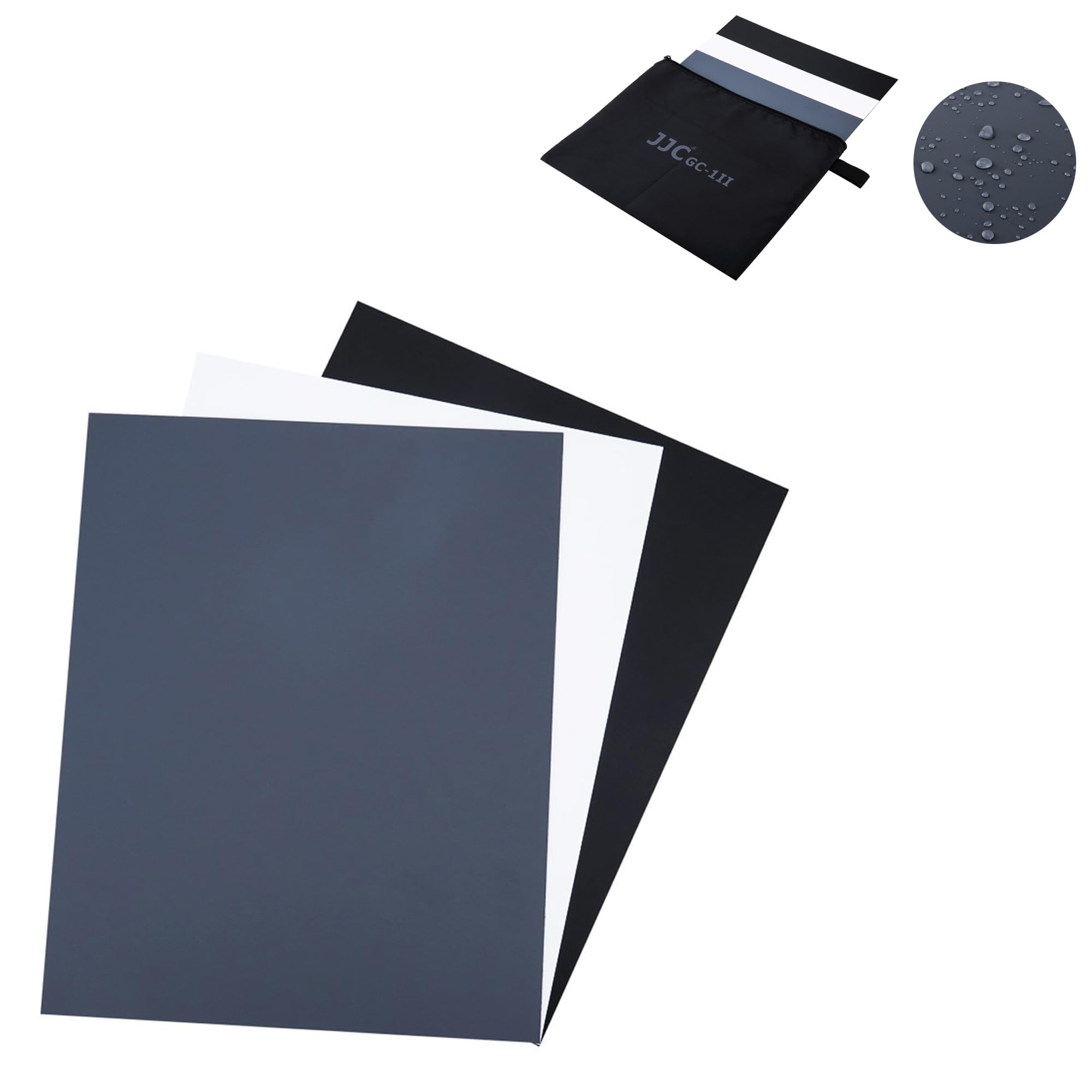
Three rigid sheets in a zippered bag, and the rigidity is the whole point. A folding panel has a wire frame around it; these are 8-by-10 PVC boards that sit flush on a table, lean against a wall, or get propped behind a product without a corner curling up into the shot.

The set covers the three references that matter in post: an 18% gray for the mid-tone, a white for custom balance and a highlight reference, and a black for the shadow end. Having all three at the same size means you can put them in one frame and come away with what you need for a curve. The pouch is divided into sections, which keeps the faces from grinding against each other in transit.

PVC is what makes these worth carrying. Paper cards bend, delaminate at the edges, and hold a crease you cannot flatten out again. These do not, and after a season of being propped, stacked, and shoved under a light stand, the faces still read clean.

Pros

  • Gray, white, and black references in one set
  • Rigid PVC lies flush and resists creasing
  • Divided zip pouch protects all three faces

Cons

  • Three boards take more bag space than a foldable
Our verdict

Our pick for studio and tabletop work: three PVC sheets that stay flat, wipe clean, and give you a black point alongside gray and white.

Check Latest Price
4

Best Budget Set

Macolink 3-Card Set

91 /100
Keeper Score Outstanding

Key details

Finish
Matte, waterproof
Card Size
3.35 x 2.2 in
Attachment
Detachable lanyard
Set Contents
Gray, white, black cards
Check Price on Amazon

Three references for less than most single cards here: a gray, a white, and a black, each 3.35 by 2.2 inches and strung on a clip lanyard. We buy them two sets at a time and leave one in every bag, because the card you have beats the card at home. At this size they will live in a jacket pocket, a glovebox, or the lid of a camera bag without a second thought.

The matte finish is what makes them usable. They are waterproof plastic with a low-sheen surface, so a flash fired at them does not come back as a hotspot, and a splash of rain or coffee wipes off. The lanyard unclips, which matters more than it sounds: hang the gray off a light stand, then unclip it and swap in the white without fishing around in a pocket.

Treat them as consumables. They are a reference, not an instrument, and the day a face picks up a scratch is the day you replace it rather than squint at it. That is an easy call at this end of the price range, and it is most of why we are comfortable letting these travel loose in a bag.

Pros

  • Gray, white, and black cards for very little
  • Matte waterproof finish resists flare and spills
  • Detachable lanyard clips to a stand or bag

Cons

  • Smaller than a playing card, so close range only
Our verdict

The cheapest way to get a gray, white, and black reference into every bag you own, and genuinely useful anywhere you can get close to the subject.

Check Latest Price
5

Best Set for Hanging

Anwenk Large 3-Card Set

90 /100
Keeper Score Outstanding

Key details

Finish
Matte, waterproof
Card Size
5.3 x 7.28 in
Attachment
Lanyard with detachable clip
Set Contents
Three calibrated cards
Check Price on Amazon

Hanging the card at the subject's height, in the subject's light, is the difference between a balance that works and one you fight in the edit. This set makes that easy: the lanyard has a detachable clip, so it goes around a light stand, a tripod knob, or a belt loop and stays where you put it while you frame.

At 5.3 by 7.28 inches the cards are big enough to read from a few feet and light enough to leave on the strap all day. That middle size is the one we reach for most, because it is neither a wallet card you have to walk up to nor a panel you have to unfold. Three cards come in the pack with the lanyard, so you are not moving one card between kits.

Where it lands for us is the middle of this guide: more card than a pocket set, less fuss than a pop-up, and already assembled on a clip. It hangs on a stand and stays there for the whole session, and that habit is what actually gets a balance set rather than guessed.

Pros

  • Detachable clip lanyard hangs from a stand
  • 5.3 x 7.28 in reads from a few feet back
  • Three cards in the pack, not one

Cons

  • Flat cards, so no folding down to pack
Our verdict

A mid-size set whose clip lanyard hangs the card at subject height, which is the single habit that makes a balance reading trustworthy.

Check Latest Price
6

Metering Flat Subjects

DGK 8x10 Gray Card

86 /100
Keeper Score Excellent

Key details

Coating
None
Included
User guide and warranty
Material
Paper
Card Size
8 x 10 in
Check Price on Amazon

It is a sheet of 18% gray paper, 8 by 10 inches, with a short user guide and a warranty card in the envelope. No white, no black, no frame, nothing to fold. For some jobs that is exactly the right amount of card: it lies dead flat on a table or a wall, it covers a big chunk of frame from where the camera sits, and there is nothing between the gray and the light.

We keep ours in a drawer rather than a bag. For a setup where the card never leaves the room, that works: it sits flat against a backdrop, it covers enough of the frame to take a reading off a wall, and there is no frame lifting it off the surface the way a pop-up panel does. The uncoated face also means nothing to flake or peel, which is more than the laminated cards can say.

If the card needs to live in a camera bag, this is the wrong one, and that is the boundary worth being clear about. Buy it for a room where it stays put, a copy stand, a small studio, a wall you meter once a week, and the plainness stops being a compromise and starts being the point.

Pros

  • Lies dead flat for walls and flat-lays
  • Uncoated matte face, nothing to flake
  • Low enough cost to treat as replaceable

Cons

  • Paper bends and is not water resistant
  • Gray only, with no white or black reference
Our verdict

A plain sheet of 18% gray for metering a flat subject or checking a reading, cheap enough that replacing it when the corners go is not a decision.

Check Latest Price
7

Light Travel Kit

Sedremm 12x12 Foldable Card

88 /100
Keeper Score Excellent

Key details

Sides
18% gray and white
Weight
2.39 oz
Included
Carry pouch
Open Size
12 x 12 in (30 x 30 cm)
Check Price on Amazon

Two 12-inch pop-ups sit in this guide, and the gap between them is small enough to spell out. This one weighs less, costs a little less, and carries a one-year warranty where the Lightdow offers 90 days. It also opens with a snap that made us jump the first time.

The format is the same: a gray face for exposure and a balance reference, and a white reverse for a custom balance in camera. Open it up and it holds a 12-inch working area, which is enough to fill the frame on a wide interior rather than just a portrait.

The risk with any pop-up is the spring. A panel that will not open flat is a wobbly target, and the corner that stays slightly folded is the corner that catches the light. Open it fully, press the frame flat, and check it before you trust a reading off it.

Between the two we still take the Lightdow, for the tighter reflectance figure and the stiffer frame. We take this one when the budget is the deciding vote, or when a longer warranty matters more than a decimal point on a specification sheet.

Pros

  • Gray and white on one double-sided panel
  • Folds into a compact carry case
  • One-year warranty
  • 2.39 oz, light enough to clip on a bag

Cons

  • Spring does not always open it flat
Our verdict

The other 12-inch pop-up worth knowing about: lighter and less expensive than our top pick, with a longer warranty behind it.

Check Latest Price
8

Wide Interior Shots

Neewer 8x10 Gray/White Set

86 /100
Keeper Score Excellent

Key details

Weight
4.6 oz
Card Size
8 x 10 in
Reflectance
18% gray, 90% white
Set Contents
Gray and white cards
Check Price on Amazon

Two 8-by-10 boards, gray on one and white on the other, with reflectance figures attached: 18% for the gray and 90% for the white. That pairing is the useful part, the gray for a mid-tone reading and the white for a custom balance, and at this size you can shoot either from across a room.

Size cuts both ways. These cover a wide interior frame in a way no pocket card can, and they are stiff enough to prop against a wall or lay on a floor without curling at a corner. They also take up more room in a bag than any folding panel here, which makes them studio and vehicle cards rather than pocket ones.

The gray is the face to rely on. The white is the weaker of the two: it reads darker than a true white, so do not use it as your highlight clipping reference, and check a custom balance against a second card before you commit a whole shoot to it.

For exposure work, none of that gets in the way. A big flat 18% target is the easiest way to take a reading off a wall or a backdrop, and the white comes along for the ride without adding weight to the decision. We keep this pair for interiors, where the size earns its place and the white rarely leaves its sleeve.

Pros

  • Stated 18% gray and 90% white in one pair
  • 8x10 boards prop flat without curling
  • Covers a wide interior frame

Cons

  • White side reads darker than true white
Our verdict

A big, inexpensive pair of flat cards for wide interiors and copy work, as long as you treat the white side as a rough reference rather than gospel.

Check Latest Price

How We Chose and Tested the Gray Cards

We built the shortlist from specs rather than reputation: cards claiming a true 18% reflectance, in sizes from wallet-sized to 12-inch panels, in rigid and folding formats, and we noted which ones actually ship with a pouch or a white and black companion card. From that pool we tested 14 over four months. Price was a filter, not a ranking — in this category a low price usually means thinner material or a coating that shines, not a worse neutral.

Every card went through the same loop. I built a tabletop scene with window light mixed with a tungsten lamp — the combination that trips up auto white balance most reliably — shot each card, then balanced the files off it and compared the numbers. A genuinely neutral card pulls red, green, and blue to nearly the same value; the ones that drifted warm or cool showed up immediately when the same scene was corrected against all 14.

Then we handled them the way they get handled in real use. The folding panels were opened and closed a few dozen times to see whether they creased, warped, or sprang back flat. I slid each card into a back pocket and the front pouch of a camera bag to see how it survived an afternoon out. We raked a light across every surface to check for sheen, since a glossy card flares and gives you a reading you can't trust, and noted whether the finish grabbed fingerprints.

Last, we compared what arrived against what the listing promised, because a missing pouch or a card that won't lie flat changes the value math. The ones that held their size, read neutral, folded flat, and still looked clean after a month of handling rose to the top.

How to Choose a Gray Card

Gray side, white side, and what each one is for

The two faces do different jobs. The 18% gray gives your meter a mid-tone to read and gives your editing software a neutral patch to sample, so it covers exposure and balance after the fact. A white face is for setting a custom balance in camera, which is what you want when you are handing over JPEGs or video and cannot fix it later.

Decide which one you actually use before you buy. If you shoot RAW and correct in post, the gray alone carries you. If finished files leave your hands on set, get a card with both sides.

Size is a distance question

Bigger is not automatically better. The card has to fill enough of the frame from where you can physically stand it: a three-inch card works at arm's length and is useless across a room, a five-by-seven works from a few feet, and a 12-inch panel covers a wide interior from where the camera sits.

Here is the trap worth knowing. Compact in a listing means it fits in a bag, not that it fills a frame at ten feet, and a card you cannot fill the frame with gives you an average of everything in front of the lens. Measure the distance you actually shoot from before you pick a size.

Matte surfaces, flat cards, and flare

A gray card only tells the truth if the light hitting it is the light hitting your subject. A glossy face bounces a strobe straight back at the lens, so a matte surface is worth more than an extra inch of card.

Rigidity matters for the same reason. A rigid board lies flush on a table and stays where you put it, while a folding panel depends on its wire frame to hold the face flat. Angle any card a few degrees off the light axis and meter from where the subject stands, not from behind the camera.

Material decides how long it stays neutral

Paper cards are cheap and lie beautifully flat, and they also bend, delaminate at the corners, and keep a crease once they have one. PVC and laminated panels survive being propped, stacked, and wiped, which is why they cost more.

Whatever you choose, a marked face is a wrong reading. A scuff sits at a different reflectance than the rest of the card, so store it in its pouch and retire it when the surface goes rather than persuading yourself it is fine.

When certified neutrality is worth paying for

Most cards are made to a target rather than measured against one. For a handful of frames corrected for a friend, close enough really is close enough, and a budget card does the job. If color is the deliverable, a stated neutrality figure and a per-card measurement removes a variable you cannot see with your eye.

Frequently Asked Questions

Final Verdict

For most photographers the Lightdow 12-inch foldable is the card to buy. It opens wide enough to take an honest reading from a few feet back, folds into a square that disappears in a bag, and states its accuracy in numbers you can compare against the rest of this list.

Pay for the WhiBal instead if a neutral result is the deliverable rather than a nice-to-have. Add the JJC set if you work on a table and want cards that lie flat. Everything else here answers a narrower question.