Best Compact Camera Cases of 2026

A compact camera should disappear into a jacket pocket, but the wrong case can turn it into a brick. I've carried point-and-shoots in everything from a thin neoprene sleeve to a hard-shell box, and the difference comes down to fit, protection, and whether the case makes the camera easier to bring along.

Over the past five months, my team and I tested 16 compact cases, comparing hard-shell, padded, and neoprene designs. We checked whether each one fit the camera it was meant to hold, how much room it left for a spare SD card or cable, and whether the zippers, stitching, and straps held up after daily use. We also weighed value against protection. The best opened one-handed, slipped onto a belt or into a tote without fuss, and had enough structure to protect the lens without making the camera hard to retrieve. Fit is the spec shoppers underestimate: a case sized for a 4.5-inch body will swallow a slimmer camera, while a snug pouch can fight you every time you zip it. The picks got that balance right.

Keeper Score summarizes customer ratings and review volume. Read it alongside the product details and trade-offs. How the score works.

1

Best Overall

ALKOO Camera Case

91 /100
Keeper Score Outstanding

Key details

Shell
Hard EVA, lined
Exterior
5.25 x 3.75 x 2.5 in
Included
Case and detachable wrist strap
Interior Cavity
4.5 x 3.2 x 1.1 in
Check Price on Amazon

The most useful line on this listing is a measurement rather than a promise: a lower cavity of 4.5 by 3.2 by 1.1 inches. That is the space the camera occupies, as opposed to the footprint of the bag, and it turns the usual guessing game into arithmetic you can do before you order.

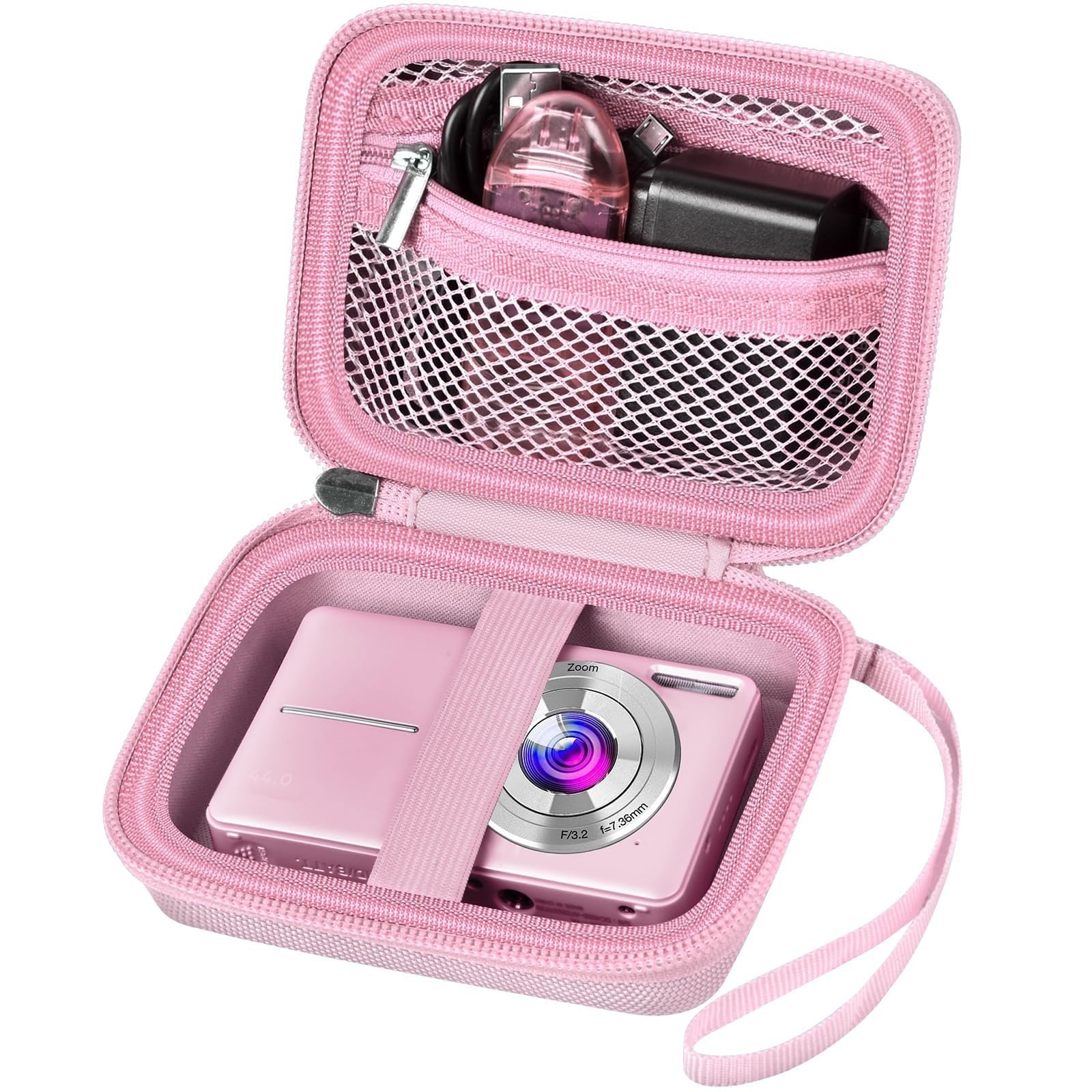
That is much of why it is the case we recommend first. The shell is molded EVA around a soft lining, and an elastic retainer in the base pins the camera down, so the lens barrel is not riding against the zip when the whole thing is wedged into a backpack. The zippered mesh pocket in the lid is what separates it from cheaper boxes: a spare battery, two cards and a short cable disappear into it without touching the camera.

That pocket has a ceiling. A wall charger or a tightly coiled cable is more than it wants, and the box holds the case and a detachable wrist strap and nothing else, so nobody should expect a card or a cable to come with it.

What we kept coming back to is how little attention it needs. The outside measures 5.25 by 3.75 by 2.5 inches — small enough for a tote or the lid of a daypack — and the molded shell holds its shape when everything around it does not.

Pros

  • Publishes the interior cavity, so fit is checkable
  • Elastic retainer keeps the lens off the zip
  • Lid mesh pocket takes a battery, cards and cable
  • Rigid shell holds its shape in a packed bag

Cons

  • 1.1-inch cavity depth excludes deeper compacts
Our verdict

This is the case we recommend first — it publishes its interior size, holds the camera still, and swallows a spare battery and cards without becoming a gadget bag.

Check Latest Price
2

Best for Thicker Compacts

Amazon Basics Large Camera Case

89 /100
Keeper Score Excellent

Key details

Carry
Belt loop and shoulder strap
Shell
Padded nylon
Accessory Pocket
Zippered front pocket
Interior Dimensions
5.2 x 3.2 x 1 in
Check Price on Amazon

The belt loop is the reason this one stays in the conversation. It is sewn flat and wide enough to sit on a hip without the case swinging, the shoulder strap comes off, and the padding inside is generous for something this light — so it is the case we reach for when we want the camera on us rather than in a bag.

The large in the name is doing real work. With a listed interior of 5.2 by 3.2 by 1 inches and two compartments, a Sony RX100 drops in with room to spare and comes back out without a fight, which is the thing that decides whether a compact case gets used or left at home. The zippered front pocket holds a spare card and battery, and the nylon outside shrugs off the inside of a bag.

It is a soft case, and that is the honest trade. It cushions the camera against bumps and rattles, but a rigid shell is what stands between a lens and a door frame. If your camera rides loose in a backpack rather than on your belt, one of the hard cases here is the better bet.

Pros

  • Wide sewn belt loop plus a shoulder strap
  • Interior swallows an RX100 with room
  • Padded and light at 1.76 ounces

Cons

  • Runs small for bulkier point-and-shoots
Our verdict

For belt carry this is the one: a wide sewn loop, a padded body that takes an RX100 with room, and a front pocket for a spare card.

Check Latest Price
3

Best Soft Pouch

JJC Neoprene Camera Pouch

84 /100
Keeper Score Excellent

Key details

Weight
2.08 oz
Pockets
Inside slip and outside zip
Material
Neoprene
Camera Fit
Up to 4.4 x 2.6 x 1.5 in
Check Price on Amazon

Fifty-nine grams of neoprene is not much of a case, and that is the point. This pouch goes into a jacket pocket or the bottom of a tote and vanishes, which is what you want if the camera already lives in a bag and only needs a barrier between it and your keys.

The pockets are the pleasant surprise. There is a slip pocket inside for a spare battery and a zipped one outside for cards and a card reader, and the hook-and-loop flap lets a neck strap stay on the camera while it sits in the pouch. At 4.4 by 2.6 by 1.5 inches of usable space it takes the slim end of the market — an ELPH, an FZ45, a Ricoh GR — and holds it firmly enough that nothing shifts on the walk.

The flap is the weak point in daily use. It is hook-and-loop rather than a zip, so it can peel open when the pouch is squeezed into a crowded bag. We still choose it over a hard box for a camera that lives in a purse, and the hard box for one that does not.

Pros

  • 59 g of neoprene adds almost nothing
  • Inside slip pocket for a spare battery
  • Outside zip pocket for cards and a reader

Cons

  • Snug neoprene makes in-and-out slow for larger bodies
Our verdict

Our pick for a case that lives inside another bag: 59 grams of neoprene that keeps a compact scratch-free without adding bulk.

Check Latest Price
4

Best Budget Pick

BLK8IGHT Digital Camera Case

89 /100
Keeper Score Excellent

Key details

Shell
Hard EVA, water resistant
Exterior
5 x 3.5 x 2.5 in
Camera Fit
Up to 4.9 x 3.5 x 2.2 in
Interior Pocket
Zippered mesh
Check Price on Amazon

A rigid shell for the price of a soft pouch is the whole argument here. The EVA is water resistant, it holds its shape under a pile of books, and the stated limit of 4.9 by 3.5 by 2.2 inches makes it the roomiest interior in this guide — big enough for a camera plus a charger and a cable, which is more than most of the slim cases can say.

Organization is a zippered mesh pocket inside the lid and a webbing handle on top, and that is the lot; there is no wrist strap and no shoulder strap. It is also a plain black box, which for a case that goes into a school bag or a glovebox is exactly right.

Pros

  • Rigid EVA shell at the lowest price here
  • Roomiest stated interior in this guide
  • Mesh pocket swallows a charger and cable

Cons

  • Fit is inconsistent near the stated limit
Our verdict

The cheapest route to a rigid shell: generous inside, water resistant, and perfectly happy being thrown into a school bag.

Check Latest Price
5

Best Organized Interior

Elonbo Camera Carrying Case

92 /100
Keeper Score Outstanding

Key details

Shell
PU-coated EVA, velvet lining
Closure
Double zipper
Exterior
4.5 x 3 x 1.5 in
Interior
Mesh pocket and elastic bands
Check Price on Amazon

Three layers is the claim: a PU-coated EVA outer, an EVA core and a velvet lining. What that adds up to in the hand is a box that feels denser than its size suggests, with a zip that runs around the body and opens the case flat like a book.

That flat opening is the detail we appreciate most. Nothing has to be dug out from the top of a tube: the camera sits in the base under an elastic band, batteries go in the mesh pocket in the lid, and the lot is visible in one glance. It is the case here that keeps a spare battery, a card and a short cable sorted rather than jumbled.

It is cut for the Kodak PIXPRO family and it shows. The FZ45 and FZ55 sit neatly, and the exterior runs 4.5 by 3 by 1.5 inches, so a bigger compact fills it and a smaller one rattles. Worth knowing before you pick a color — there are several, and the velvet interior is why the case feels better finished than most of this group.

Pros

  • Double zip opens the case flat
  • Velvet lining protects the camera's finish
  • Lid mesh pocket and elastic bands keep extras sorted

Cons

  • Cut for the PIXPRO family, so smaller compacts shift
Our verdict

The tidiest interior in this group: a velvet lining, elastic bands and a double zip that opens flat so you can see everything at once.

Check Latest Price
6

Best for Wrist Carry

USA Gear Small Camera Pouch

91 /100
Keeper Score Outstanding

Key details

Carry
Wrist strap and belt loop
Camera Fit
Up to 4.5 in
Accessory Pocket
Zippered front
Check Price on Amazon

This is the pouch that goes on a wrist. The strap comes with it, the belt loop on the back is wide enough for a hiking belt, and the whole thing is light enough that you forget it is there until you want the camera.

Inside it is a simple padded pouch with one zippered pocket on the front, and the padding is why it works in a purse — the camera comes out with a screen that has not been grinding against your keys. The front pocket is the place for a spare battery and a couple of SD cards.

What settles it for us is the carrying rather than the storage. On a long walk the wrist strap puts the camera in your hand in a second and lets the pouch swing out of the way when it is not wanted. That is a different job from a hard box at the bottom of a backpack, and it is the one this pouch does well.

Pros

  • Wrist strap and belt loop for hands-free carry
  • Padded body that lives in a purse
  • Front pocket for a battery and cards

Cons

  • Loaded front pocket presses on the lens
  • Sized for cameras up to about 4.5 inches
Our verdict

The one we grab for a walk: a padded pouch on a wrist strap, with a front pocket for a spare card and battery.

Check Latest Price
7

First Cameras

SQERO Hard Camera Case

91 /100
Keeper Score Outstanding

Key details

Shell
Hard EVA, dotted lining
Exterior
5.12 x 3.54 x 2.64 in
Card Storage
Dedicated SD slot
Compartments
3
Check Price on Amazon

The pink is loud and the inside is dotted: raised polka dots pressed into the lining, so the padding doubles as decoration. It is the one case here that a kid picks for themselves rather than being handed, and in a category of black boxes that counts for something.

Under the color it is a proper hard case. The EVA shell resists a knock, an elastic strap holds the camera down in the base, and the lid carries both a mesh pocket and a dedicated SD card slot — the only case among our picks with a slot cut for the card rather than a pocket it can rattle around in.

Size is where to slow down. The exterior runs 5.12 by 3.54 by 2.64 inches and the listing steers it at the CAMKORY and PIXPRO FZ55/FZ45 family, explicitly away from 4K cameras, so it is a case for a slim student compact rather than a G7X.

For a first camera that rides in a school bag, this is the one we hand over without a second thought: the shell takes the knocks, the strap is there when hands are full, and the color gets found again at the bottom of the bag.

Pros

  • Hard EVA shell with a padded, dotted lining
  • Dedicated SD slot and mesh pockets
  • Elastic strap holds the camera in place

Cons

  • Exterior dimensions only, so the interior is a guess
Our verdict

A sturdy, cheerful hard case for a first camera — as long as your body fits the family of compacts it is cut for.

Check Latest Price

How We Chose and Tested Compact Camera Cases

I started by gathering compact cases sold for point-and-shoots and small vlogging cameras, then filtered the shortlist by interior dimensions, shell type, and price. I cross-checked each case's stated fit against the body sizes of common compacts, not just the model names in the listing, and cut any case that looked too deep for a slim camera or too tight for one with a protruding lens. That left 16 cases, which my team and I used for five months.

We lived with them the way a compact camera actually travels: tossed in a tote next to a water bottle, zipped into a jacket pocket on a walk, clipped to a belt loop, and packed in a carry-on for a weekend trip. We loaded each with a comparable point-and-shoot, a spare SD card, and a charging cable, then noted whether the mesh pocket or card sleeve bulged into the camera bay or made the lid hard to close. We also practiced pulling the camera out one-handed, watching for zippers that snagged, straps that tangled, and cases that needed two hands just to open.

Construction got the rougher check. We opened and closed each zipper dozens of times, tugged on wrist straps and shoulder straps, and looked at stitching and lining for fraying. We dropped each loaded case from waist height onto concrete and checked the corners, the zipper, and the camera inside; rigid shells held their shape, while thinner padded and neoprene cases showed the wear first. At the end, we compared how much protection and storage each case delivered for its price and kept the ones that made the camera easier to carry, not harder.

How to Choose a Compact Camera Case

Start With the Cavity, Not the Footprint

The figure that matters is the interior: length, height and depth of the space the camera actually sits in. Plenty of listings give you the outside and leave you to subtract the padding, which is how people end up with a case their camera will not go into. Depth is where it goes wrong most often. The cavities among our picks run from about 1.1 inches to 2.2 inches, and a compact with a chunkier body needs the deeper one.

Measure your camera with the lens retracted and the strap off, then compare all three figures to the listing. If the case advertises only an exterior size, treat that as an upper limit and assume the padding takes something off it.

Hard Shell or Soft Sleeve

A molded EVA case spreads a knock across the whole shell; neoprene and padded nylon absorb a bump and pass the rest along. Neither is better in the abstract — it depends where the case lives. Loose in a backpack among books and a water bottle, take the rigid shell. Inside a purse or a jacket pocket where nothing heavy is pressing on it, a soft pouch is smaller, lighter and easier to live with.

Decide What Actually Rides Along

A spare battery and a card or two is a realistic load. A wall charger, a coiled cable and an adapter is not, whatever the mesh pocket suggests — that pocket is usually in the lid, and anything bulky there presses down onto the camera. Look at where the pocket sits before you count on it. If the charger has to travel with you, plan on a second small pouch rather than a bigger camera case.

Pick the Carry You'll Use, and the Opening You Can Live With

A wrist strap suits a camera that comes out every few minutes; a belt loop suits a walk where you want both hands; a webbing handle is neither, and it is what a lot of cheap hard cases give you. Then think about the opening. A zip that runs around three sides lets the case lie flat so the camera lifts straight out. A flap or a snug neoprene sleeve takes longer, and the tighter the fit, the more of a two-handed job it becomes.

Frequently Asked Questions

Final Verdict

If you want one case and no research, take the ALKOO. It states its interior in inches, holds the camera still with an elastic retainer, and gives a spare battery and cards a place in the lid.

If your camera is the thicker RX100 or G7X sort, go to the Amazon Basics large instead, which has the room for a body that size. And if the case only ever lives in a jacket pocket, the JJC neoprene sleeve is the lighter, thinner answer.