Best Close-Up Filters of 2026

A close-up filter is the least expensive way into macro photography: a threaded ring of glass that shortens your lens's minimum focus distance so a flower, a coin, or a bee's wing can fill the frame. There's nothing electronic and no light loss — it simply screws onto the front of a lens you already own. What separates a good one from a bad one is everything the diopter number on the rim doesn't tell you.

Over four months, my team and I screwed 14 close-up filter sets onto lenses with filter threads from 40.5mm to 77mm, shooting at the kitchen table, in the garden, and on a few windy hikes where nothing held still. Stacking two filters for extra magnification, leaning on autofocus at minimum distance, and checking the corners at wide apertures sorted the sets out fast.

One thing worth knowing before you buy: a four-filter set is usually a better value than a single strong diopter, because the weak ones are forgiving while the +10 punishes everything. And the pouch matters more than it sounds once you're swapping glass outdoors. The picks below are the sets that stayed sharp, actually fit, and didn't cost much.

Keeper Score summarizes customer ratings and review volume. Read it alongside the product details and trade-offs. How the score works.

1

Best Overall

K&F Concept 52mm Close-Up Set

87 /100
Keeper Score Excellent

Key details

Case
Hard EVA case
Coating
12-layer anti-reflective
Diopters
+1, +2, +4, +10
Thread Size
52mm
Check Price on Amazon

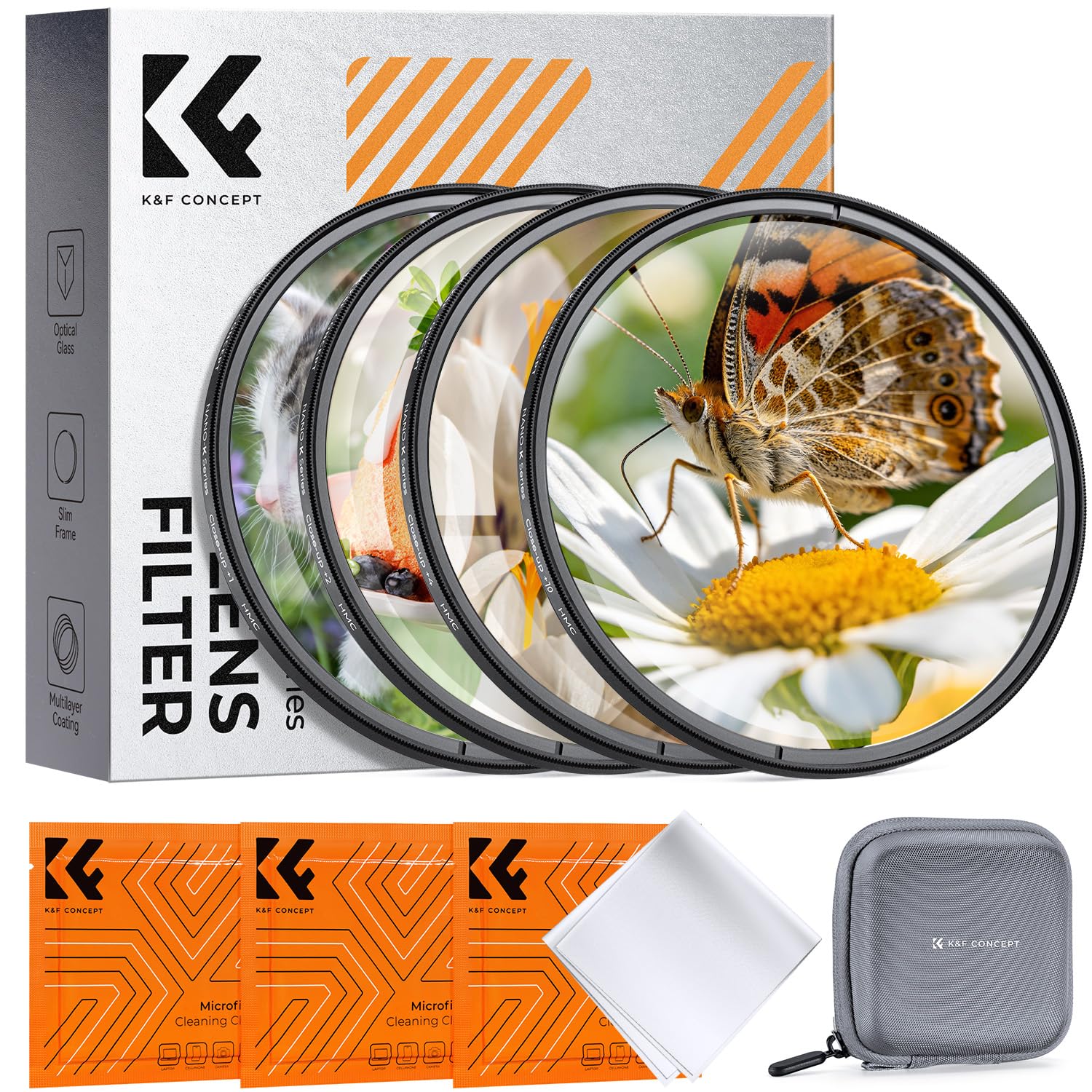
Two 52mm sets sit at the front of this group, and the K&F is the one we reach for first. It costs more than the Vivitar kit that fits the same lenses, and the money goes into the parts that decide whether a close-up looks clean: optical glass with a 12-layer anti-reflective coating, a metal ring, and a hard EVA case instead of a soft pouch. A close-up filter is a magnifier held in front of your lens, and every glass surface in that stack is somewhere stray light can bounce. Coatings are how a maker keeps that light out of the picture, and this is the most specific coating claim in the group.

The four strengths are +1, +2, +4 and +10. The +1 and +2 barely change how the lens handles and suit flower-and-texture work where you still want breathing room; the +4 is where a kit zoom starts behaving like a macro lens, and it's the one we spend most of our time on. Metal rings earn their keep too. They cross-thread less often than plastic ones, and a filter jammed onto the front of a lens is a bad afternoon.

52mm is the thread on a great many 50mm f/1.8 primes and kit zooms, which is why this set suits so many first macro attempts. It doesn't turn a cheap lens into a macro lens — corners soften wide open, and the coating is what keeps contrast alive when the light is behind your subject. That's a trade we're happy to make, and it's why this is the set to buy if you expect to use close-ups more than once.

Pros

  • 12-layer coating holds contrast in bright light
  • Metal ring threads cleanly and resists binding
  • Hard EVA case protects the filters in a bag
  • Four strengths cover gentle to extreme close-ups

Cons

  • The +10 needs support to use well
Our verdict

If you own a 52mm lens and want close-ups that hold their contrast, this is the set we hand people: coated glass and metal threads for not much more than the bare-budget kits.

Check Latest Price
2

Best Budget

Vivitar Series 1 52mm Set

87 /100
Keeper Score Excellent

Key details

Diopters
+1, +2, +4, +10
Included
Pouch with sleeves
Thread Size
52mm
Filter Frame
Plastic
Check Price on Amazon

The least expensive set here, and the one we point people toward when they aren't sure macro is for them. Four filters — +1, +2, +4 and +10 — on a 52mm thread, in a plush pouch with a sleeve for each. The glass does what a diopter is supposed to do: it lets a 50mm or a kit zoom focus close enough to fill the frame with a coin, a leaf, or a bee. We've watched the jump that makes to someone who has only ever shot at arm's length, and it's bigger than most lens upgrades.

What you accept is a shorter optical leash. Corners go soft wide open, the +10 leaves so little depth of field that we keep it in its sleeve most of the time and work with the +2 and +4, and hand-holding takes a burst of frames rather than one careful press. None of that is a dealbreaker at this tier. It's the nature of a screw-on magnifier, and it's why the price is what it is.

The pouch matters more than it sounds. Four loose filters in a camera bag become four scratched filters, and the individual sleeves keep them apart. For a first set, a second kit, or a lens you only occasionally want to get close with, this does the job and leaves money for the tripod you'll want next.

Pros

  • Cheapest route to a first macro set
  • Pouch holds each filter in its own sleeve
  • Fits common 52mm primes and kit zooms

Cons

  • Plastic filter frames feel less precise
Our verdict

Buy this one if you want to find out whether macro is your thing without spending on it: four filters, a 52mm thread, and a pouch that keeps them usable.

Check Latest Price
3

Best for Canon Kit Lenses

JJC 58mm Close-Up Set

82 /100
Keeper Score Excellent

Key details

Glass
Optical glass
Diopters
+2, +4, +8, +10
Thread Size
58mm
Filter Frame
Aluminum alloy
Check Price on Amazon

Canon's 18-55mm kit zoom takes a 58mm filter, and JJC built this set around exactly that lens — the listing names the Rebel bodies and the EF-S zoom, which is more specific than most. The progression is +2, +4, +8 and +10. The frames are aluminum with a matte black interior to cut reflections, the glass is optical, and a pouch comes in the box.

We think the +2 to +8 spread is the sensible part of this set: those middle strengths are where a kit zoom still behaves predictably, and the +8 gives you a strong option without pushing the lens right up against the subject. Expect to focus manually at the top end. With a diopter on the front, the camera often can't find anything to lock onto, and turning the ring while rocking a half inch forward and back gets the shot. For a Canon kit zoom, that's the whole job done.

Pros

  • Sized and specified for Canon's 58mm kit zoom
  • Aluminum frames with a matte interior
  • Optical glass with clean, precise threads

Cons

  • Set starts at +2 with no +1
  • Maker cautions against stacking
Our verdict

The straightforward choice for a Canon 58mm kit zoom, with a strength spread that stays useful and aluminum frames that take a thread cleanly.

Check Latest Price
4

Best for Small Threads

X-SweetDream 40.5mm Set

87 /100
Keeper Score Excellent

Key details

Mount
Double-threaded
Diopters
+1, +2, +4, +10
Included
Pouch, lens cap, cloth
Thread Size
40.5mm
Check Price on Amazon

Threads on both sides of every filter is the practical feature here. You can screw a polarizer onto the front to cut reflections on a wet leaf, or add a second diopter for more magnification, and the kit also throws in a lens cap and a microfiber cloth. It's the only set here in 40.5mm, the thread on Sony's 16-50mm power zoom and a long list of compact cameras — the small lenses people most often want to push into close-up work.

The strengths match the better sets: +1, +2, +4 and +10. Where this one asks for patience is stacking. Two diopters multiply the magnification and every flaw with it, so the double thread is better used for a polarizer than for a second magnifier. Detail holds up in the middle of the frame; the corners are where a set at this price shows its price.

For a small lens and a small outlay, this is a lot of kit, and the pouch fits in a jacket pocket. We took it as the pick for anyone shooting a compact or a Sony kit zoom: the size is the point, and the price makes it easy to find out whether close-up work sticks.

Pros

  • Double-threaded filters accept a polarizer
  • Includes lens cap and cleaning cloth
  • Only 40.5mm set here for small lenses

Cons

  • Autofocus hunts at stronger settings
Our verdict

For compact and mirrorless lenses with small threads, this is the set to start with: four strengths, double threading, and a price that invites experimenting.

Check Latest Price
5

Best for Telephoto Zooms

NiSi NC 77mm Close-Up Kit

87 /100
Keeper Score Excellent

Key details

Weight
11.6 oz
Adapters
67mm and 72mm step-up rings
Thread Size
77mm
Designed For
70-300mm lenses
Check Price on Amazon

The best glass in this group, and the one we trust for a shot we care about. NiSi's close-up lens is a single optic built for 70-300mm zooms rather than a pouch of four diopters, and it comes with 67mm and 72mm step-up rings to mount on its 77mm thread. What the money buys is sharpness across the focal plane instead of soft corners — the kind of result where you stop thinking about the filter and start thinking about the subject.

It changes how you shoot. The lens hangs 330 g off the front of the camera, enough to alter the balance of a small body and enough to make a monopod or a tripod collar worth having. It's also one strength rather than four, so you zoom and move rather than swapping filters — closer to how a real macro lens behaves than the screw-on sets are.

That makes it a specialist's buy. If you already own a 70-300mm and photograph small subjects more than occasionally, it's the best close-up money in this article. If your longest lens is a kit zoom, the four-filter sets do more for less.

Pros

  • Sharp across the focal plane
  • Step-up rings for 67mm and 72mm lenses
  • No light loss compared with extension tubes

Cons

  • 330 g on the front changes lens balance
  • Thread coverage stops at 67mm to 77mm
Our verdict

Own a 70-300mm and shoot close-ups seriously? This is the one worth the money, with sharpness across the frame the filter sets can't match.

Check Latest Price
6

Best Budget 77mm

Ultimaxx 77mm Close-Up Kit

87 /100
Keeper Score Excellent

Key details

Glass
Optical glass
Coating
Multi-coated
Diopters
+1, +2, +4, +10
Thread Size
77mm
Check Price on Amazon

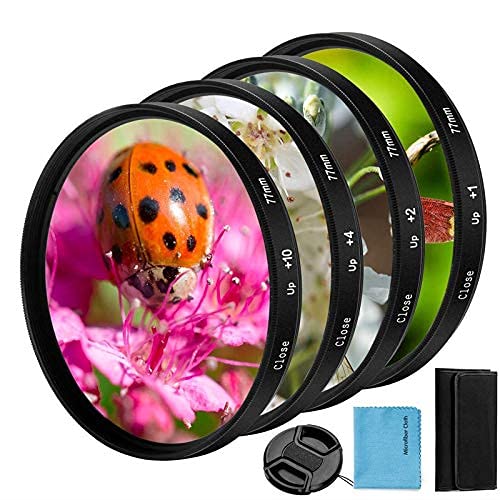
Same 77mm thread as the NiSi, a fraction of the price tier, and four filters instead of one. The Ultimaxx kit gives you 1, 2, 4 and 10 diopters in multi-coated optical glass, plus a protective pouch. If you've been eyeing a premium close-up lens and can't justify it yet, this is how you find out whether you actually shoot macro.

In hand it's better than the price suggests: the glass is clear, the frames take a thread cleanly, and the magnification steps are as advertised. The +2 and +4 produce the pictures most people want, and the +10 is the usual handful — a big front element held close to the subject with almost no depth of field to work with. A 77mm filter is also a lot of glass to hang off the end of a zoom, so a lens with a tripod collar is the happiest host.

We rate it the value pick of the two 77mm options: good enough to learn on, inexpensive enough to keep in the bag after you upgrade. What it won't do is match the NiSi at the edges, and at this tier that's the deal you're making.

Pros

  • Four diopters in optical glass for 77mm lenses
  • Clear glass and cleanly fitting threads
  • Far less expensive than the premium 77mm option

Cons

  • Needs a step-up ring on narrower lenses
Our verdict

A sensible first 77mm close-up kit: four diopters, clear glass, and enough quality to tell you whether you want the premium lens later.

Check Latest Price
7

72mm Lenses

GREEN.L 72mm Close-Up Set

82 /100
Keeper Score Excellent

Key details

Coating
None
Diopters
+1, +2, +4, +10
Thread Size
72mm
Filter Frame
Aviation aluminum
Check Price on Amazon

The 72mm thread is the least common size in this group, which makes this the most situational set here — and the one to look at if your lens takes it. GREEN.L builds the frames from aviation aluminum and uses optical glass rather than resin, and the kit arrives with a pouch and a cleaning cloth.

The strengths are the familiar +1, +2, +4 and +10. On a 72mm lens, usually a bigger zoom, that spread behaves much as it does elsewhere: the +1 and +2 are gentle enough to leave on for a walk, and the +4 is the one that earns its keep. The wider mount also means the assembly feels like part of the lens rather than something clipped onto it.

Our note on this set is about light rather than build. In open shade, indoors or on a copy stand it's pleasant to work with; into a low sun, contrast drops and the pictures look flatter than they should. A lens hood, or a hand held to shade the filter, fixes most of it.

If the size fits and the light is manageable, this is a well-made set at a midrange tier, and the aluminum frame is the part that will still feel right in a few years. It isn't the set to buy before you know your lens's thread size. It is the one to buy once you do.

Pros

  • Optical glass in an aluminum frame
  • Covers the 72mm thread the others skip
  • Pouch and cleaning cloth included

Cons

  • 72mm thread only, so other lenses need an adapter
Our verdict

Own a 72mm lens? This is a well-made set of optical glass in aluminum frames, with four strengths that cover everything from a whole flower to a stamen.

Check Latest Price

How We Chose and Tested the Close-Up Filter Sets

To build the shortlist, I read through listings and reviews for close-up sets in thread sizes from 40.5mm to 77mm, narrowing by diopter range, whether the glass was described as multi-coated or plain, and how many filters a set included for the money. We tested 14 sets over four months, each one used the way a close-up filter actually gets used: screwed on for twenty minutes in the garden, then back in the bag.

Shooting happened at a kitchen table with coins, watch dials, and printed text; in the garden on dew-covered leaves and whatever insect cooperated; and on hikes where the light kept shifting. I shot the same subjects at every diopter in each set, then opened the frames at full size to look for corner softness, color fringing along high-contrast edges, and whether straight lines bowed near the frame edges. Stacking a +1 on a +2 showed which sets held up past their single-filter magnification and which fell apart.

Focusing got its own pass. I half-pressed to see whether autofocus locked or hunted at minimum distance, then switched to manual and noted how much of the focus ring's travel produced a sharp frame, since the strong diopters leave very little room. Fit was checked by mounting each filter on more than one lens, with step-up rings where the set included them, watching for cross-threading or a filter that sat proud of the barrel. Finally, the sets rode loose in camera bags for the length of the test, were cleaned with a microfiber cloth, and I checked the coatings and retaining rings for wear at the end.

How to Choose Close-Up Filters

Start with the thread size, not the strength

The figure after the diameter symbol on your lens barrel — or printed inside the lens cap — is the one measurement that can rule a set out completely. Every set here comes in a single size: 40.5mm, 52mm, 58mm, 72mm or 77mm. A step-up ring lets a narrower lens take a wider filter, but it adds another threaded joint to the stack and one more place for a filter to bind. Check the marking before you fall for a diopter count. A set that doesn't screw on is a set you'll be returning.

What +1, +2, +4 and +10 actually change

Each number is a diopter, and it shortens the closest distance your lens can focus. The +1 and +2 are gentle: they let a standard lens fill the frame with a flower while you still stand back a little. The +4 is the workhorse. The +10 is a specialist — it magnifies hardest, brings the front of the lens close enough to shade the subject, and leaves so little depth of field that hand-holding becomes a timing exercise. While any of them is mounted the lens can no longer focus at infinity, so it comes off for everything that isn't close.

Coating, glass and what the extra money buys

Every close-up filter is a magnifying glass, and the cheapest ones behave like it: soft corners, colour fringing, and contrast that disappears when the sun is anywhere near the front element. Multi-layer anti-reflective coatings are the main thing more money buys, followed by metal frames that thread without binding. Two habits rescue even a budget set: stop down to f/8 or f/11 to pull the corners in, and keep the subject centered, where a diopter is sharpest. If you shoot backlit flowers or anything with sky behind it, pay for coatings first.

Focusing, stacking and keeping them clean

With a diopter mounted, autofocus often gives up — the camera hunts through a range where nothing is sharp, then locks when you least expect it. Manual focus plus a slow half-inch rock forward and back is faster. Stacking two filters multiplies the magnification and every flaw with it; a double-threaded filter is better used for a polarizer than for a second magnifier. And a case with a sleeve per filter is not a luxury. Four loose filters in a bag become four scratched filters.

Frequently Asked Questions

Final Verdict

For most people the K&F Concept 52mm set is the one to buy: coated optical glass in metal rings, four useful strengths and a hard case, at a price that still makes sense for a first macro experiment. If your lens takes 58mm, the JJC set is the direct substitute.

If you already own a 70-300mm and want the best close-up images this group can produce, the NiSi is worth the step up. And if you'd rather spend as little as possible to find out whether close-up work is for you, the Vivitar set is the least expensive way in.