Best Canon Standard Zoom Lenses of 2026

A standard zoom is the lens you leave on the camera and stop thinking about. It covers the wide shot of the room and the tight frame of your kid's face without you stepping back or swapping glass, which is why most photographers wear one out before they wear out anything else. What separates a good one from a frustrating one isn't the focal range printed on the barrel — it's the aperture, the stabilization, and whether the mount actually matches the camera you own.

I've spent the past nine months shooting with eight of them, from constant-aperture workhorses to the variable-aperture kit lenses sold with a body, and the spread in sharpness and focus speed is wider than the spec sheets let on. Two things surprise first-time buyers: mount compatibility — older DSLR glass won't fit a mirrorless body without an adapter, and crop-sensor lenses won't cover a full-frame sensor — and condition, since a lot of affordable copies are renewed or white-box, so what's actually in the box matters. The picks below are the ones I'd buy again.

Keeper Score summarizes customer ratings and review volume. Read it alongside the product details and trade-offs. How the score works.

1

Best Overall

Canon RF 24-70mm F2.8 L IS USM

94 /100
Keeper Score Outstanding

Key details

Weight
1.98 lb
Focal Length
24-70mm
Maximum Aperture
f/2.8 constant
Image Stabilization
Up to 5 stops
Check Price on Amazon

Within an afternoon of shooting with it, we stopped thinking about the bag. The RF 24-70mm f/2.8 L stayed on the body for interiors, a street market, and a round of portraits, and nothing else in this group covered all three without a swap. That is the case for a 24-70mm f/2.8 in one sentence: 24mm is wide enough for a room or a landscape, and 70mm at f/2.8 still pulls a face out of its background.

What we did not expect to lean on so hard is the stabilization. Canon rates it at up to five stops, and indoors at dusk that is the difference between shooting at a sensible shutter speed and giving up on the light. Autofocus is quick and quiet enough that we stopped noticing it, which is the highest compliment a focus motor gets. The files were sharp from wide open, and we never found ourselves stopping down out of self-defence.

Nothing about it is small. At 898 g it is the heaviest lens in this group, and on a compact body you feel that by the end of a long walk; on a bigger R body it balances and the objection disappears. The weather sealing is the part you cannot see and will be glad of, because this is a lens you keep on the camera in drizzle rather than pack away.

The control ring is the small thing we ended up using constantly. Set it to aperture or exposure compensation and you adjust without moving your eye from the viewfinder; once that becomes habit, going back to a lens without one feels clumsy.

Pros

  • Constant f/2.8 through the whole zoom
  • True 24mm wide end for rooms and landscapes
  • Up to five stops of optical stabilization
  • Weather-resistant L-series construction

Cons

  • The most expensive lens in this roundup
Our verdict

For full-frame R-series shooters who want one lens for nearly everything, this is our pick: a genuinely wide 24mm end, a constant f/2.8, and stabilization that earns its keep.

Check Latest Price
2

Best Value Constant Aperture

Canon RF 28-70mm F2.8 IS STM

90 /100
Keeper Score Outstanding

Key details

Mount
Canon RF
Focal Length
28-70mm
Weather Sealing
Weather-resistant construction
Maximum Aperture
f/2.8 constant
Check Price on Amazon

It costs a lot less than the L-series 24-70 and we carried it more often. Canon's claim that this is the smallest and lightest RF zoom with L-series-level image quality sounded like marketing until we looked at the files: they were crisp and evenly sharp across the range, with color that needed very little work. For most of a day we could not tell which lens had taken the frame without checking the metadata.

The constant f/2.8 is the reason to pay attention. It matches the maximum aperture of the 24-70mm L, so dim rooms and shallow depth of field are both on the table, and the newly designed stabilization unit kept handheld shots steady at the long end. Canon rates the sealing as equivalent to an L-series lens; we did not test that in the rain, but the mount and barrel feel tight and the focus ring has the kind of resistance that lasts.

There is one piece of arithmetic worth doing before you order. On a crop-sensor R body this frames like a 45-112mm, which is portrait and detail territory, not a walkaround. Buy it for a full-frame body and it becomes the lens that goes in the bag when you do not know what you will be shooting.

Pros

  • Constant f/2.8 for far less than the L zoom
  • Light and compact enough to carry all day
  • Weather-resistant construction
  • Sharp throughout the zoom range

Cons

  • Starts at 28mm rather than 24mm
Our verdict

A sealed, constant-aperture zoom that costs far less than the L-series 24-70 and gave up almost nothing we noticed — provided 28mm is wide enough for how you shoot.

Check Latest Price
3

Best for Full-Frame DSLRs

Canon EF 24-70mm f/2.8L II USM

92 /100
Keeper Score Outstanding

Key details

Weight
1.77 lb
Focal Length
24-70mm
Maximum Aperture
f/2.8 constant
Image Stabilization
None
Check Price on Amazon

There is no image stabilization here, and that shapes how you shoot it. On a DSLR there is no in-body system to fall back on either, so the rule is simple: keep the shutter speed at roughly one over the focal length, brace against something solid, or put the camera on a monopod. Do that and the missing stabilizer stops being a story. Forget it in a dim room at 70mm and you will see the shake.

Optics are why people put up with the rest. At f/2.8 the center is already crisp, the corners sharpen up quickly as you stop down, and the 24mm end holds together in a way plenty of standard zooms do not. Nine diaphragm blades give out-of-focus backgrounds a smooth, round quality rather than the polygonal mush a six-blade lens produces.

The ring-type USM motor is the other half of the argument. It locks fast, it is quiet, and full-time manual focus means you can grab the ring and correct without flipping a switch. We shot a dim indoor event with it and missed very little.

It is the priciest EF lens here, and that is the honest trade: you are paying for glass that does not need stopping down and a motor that does not hesitate. Mount it on a full-frame body with a decent grip and it is the lens that makes the camera feel like the tool you paid for.

Pros

  • Sharp at f/2.8 across the range
  • Fast, quiet ring-type USM autofocus
  • Nine-blade aperture for smooth backgrounds
  • Full-time manual focus override

Cons

  • Heavy at 805 g on a small DSLR body
Our verdict

The standard zoom we still reach for on a full-frame DSLR: sharp wide open, quick to lock focus, and steady in the hand once you accept that the stabilization is yours to supply.

Check Latest Price
4

Best All-In-One for APS-C DSLRs

Canon EF-S 18-135mm f/3.5-5.6 IS

88 /100
Keeper Score Excellent

Key details

Weight
1 lb
Focal Length
18-135mm
Maximum Aperture
f/3.5-5.6
Image Stabilization
4 stops
Check Price on Amazon

Eighteen to 135mm does not sound like much until you do the conversion: on a crop body it frames like a 29-216mm, which is a wide hotel room at one end and a face across a courtyard at the other. We left it on the camera for a whole trip and never reached for a second lens. That is what a standard zoom is supposed to do, and this one does it more completely than anything else here.

At 455 g it hangs off a neck strap without complaint, and the four-stop stabilization is what makes the long end usable hand-held in shade. The variable aperture is the compromise: by 135mm you are at f/5.6, so an indoor shot at full zoom means more light or a higher ISO. Outdoors, in daylight, that is a non-issue.

Build is plain but honest, with a plastic barrel, a zoom ring that turns smoothly, and a 67mm filter thread that is an easy size to find accessories for. It is an EF-S mount, so it is for crop-sensor DSLRs only and will not go near a full-frame body.

Two things worth knowing. At 18mm the extreme edges go a little soft, so frame slightly loose on architecture and crop back in later. And this version ships in a plain white box rather than retail packaging: the lens is new and the one-year warranty card is inside, but do not expect a display carton.

Pros

  • 29-216mm equivalent range on a crop body
  • Four stops of image stabilization
  • Light enough to carry all day at 455 g
  • Noticeably better image quality than the 18-55mm kit lens

Cons

  • Autofocus hunts in dim light before it locks
Our verdict

For a crop-sensor DSLR we have not found a more complete single lens: 29-216mm equivalent, light enough to carry all day, and it never made us reach for a second lens.

Check Latest Price
5

Best Budget Pick

Canon EF-S 18-55mm f/3.5-5.6 IS II

91 /100
Keeper Score Outstanding

Key details

Weight
7.05 oz
Zoom Ratio
3.1x
Focal Length
18-55mm
Maximum Aperture
f/3.5-5.6
Check Price on Amazon

Two hundred grams and a 3.1x zoom. That is the whole lens, and for a lot of people it is the whole answer: a camera body with no lens is a paperweight, and this is the least expensive way to make it a camera again. It is the classic 18-55mm range, which on a crop body is 29-88mm, wide enough for a room and long enough for a portrait if you step in.

Optically it behaves like a competent kit lens should. In the middle of the frame it is genuinely sharp, and a step down to f/8 brings the corners along with it; wide open at 18mm the edges are the soft part. In flat, bright light the files stand up well beyond what the position in the lineup implies.

Buy it as a replacement, as a second lens for a spare body, or as a first lens you do not mind scratching. It is not the lens you grow into, since there is no reach beyond 55mm and no weather sealing to speak of, but it is the one that keeps a camera in use instead of in a drawer, and that is worth more than the specification sheet suggests.

One thing for video shooters: the focus is gear-driven rather than a ring USM motor, so you will hear it working on the soundtrack. For stills it makes no difference at all.

Pros

  • Very light at 200 g on any DSLR body
  • Sharp in the center, especially stopped down
  • The cheapest lens in this group

Cons

  • No manufacturer warranty on white-box stock
  • Variable f/3.5-5.6 aperture limits indoor use
Our verdict

When a crop-sensor DSLR is sitting unused because its kit lens died, we point people here first: it is the cheapest way back into shooting, and sharper than the job requires.

Check Latest Price
6

Best for Compact RF-S Bodies

Canon RF-S 18-45mm F4.5-6.3 IS STM

86 /100
Keeper Score Excellent

Key details

Zoom Ratio
2.5:1
Focal Length
18-45mm
Maximum Aperture
f/4.5-6.3
Image Stabilization
4 stops, up to 6 with IBIS
Check Price on Amazon

Put it on a small R body and the whole kit stops feeling like a camera bag. It is the lens that comes with the camera, and it is the one that stays on because it adds almost nothing to the weight of the body. The 18-45mm range frames like a 29-72mm on APS-C, which covers family, street, and the usual holiday material without ever feeling special-purpose.

What we appreciated most is how little it asks of you. There is no bulk to negotiate when you pull the camera out of a small bag, and it fits camera cases built for the body alone. It focuses quietly and quickly enough for the kind of shooting a compact camera invites, and the STM motor is smooth enough that autofocus does not jump around in video the way older kit lenses do.

Stabilization is the part that punches above its position. Canon rates it at four stops on its own, and up to six when the body adds in-body stabilization. For handheld video and for slow shutter speeds indoors, that counts for more than the size of the lens suggests.

One quirk worth knowing if you own more than one body: on a full-frame R camera this lens switches the camera into APS-C crop mode automatically. It works, but you lose a chunk of your resolution, so treat it as an RF-S lens first and a full-frame stopgap second.

Pros

  • Small and light on a compact R body
  • Four stops of stabilization, six with IBIS
  • Quiet STM autofocus for video

Cons

  • Dim f/4.5-6.3 maximum aperture
  • Covered by a 90-day renewed warranty
Our verdict

We reach for this when the priority is a kit that disappears into a bag: tiny, stabilized, and cheap enough to keep as a spare, so long as you shoot in decent light.

Check Latest Price
7

Macro and Travel

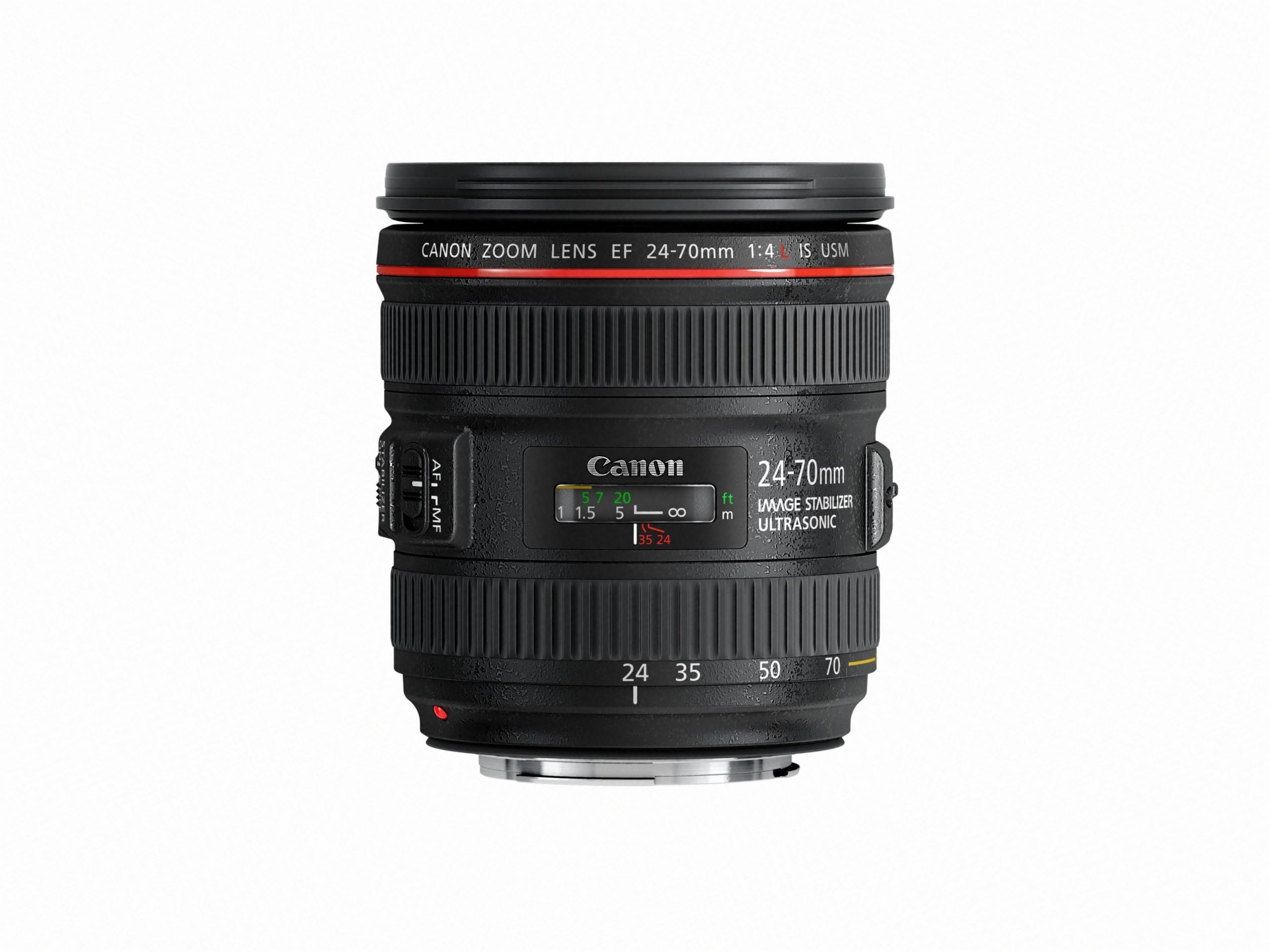
Canon EF 24-70mm f/4L IS USM

81 /100
Keeper Score Excellent

Key details

Focal Length
24-70mm
Maximum Aperture
f/4 constant
Image Stabilization
Up to 4 stops
Maximum Magnification
0.7x
Check Price on Amazon

At 70mm you flip a switch on the barrel and the lens turns into a close-focus tool, up to 0.7x magnification. That is enough to fill the frame with a flower, a watch face, or a product shot on a desk, and none of the other 24-70mm zooms here magnifies anywhere near as much. The switch is the reason this one stays in the shortlist rather than being the cheaper also-ran.

One stop separates f/4 from f/2.8, and on paper that sounds trivial. In practice it is the difference between shooting an indoor event at one ISO and the next one up, or between a shutter speed that freezes a hand and one that does not. If your subjects move indoors, that stop is the entire argument for the f/2.8 version.

Where it wins is everywhere else. The four-stop stabilization holds up at shutter speeds that would otherwise need support, and for still subjects and dim rooms the stabilizer buys back more than the aperture gives up. It is also lighter and less expensive than either f/2.8 zoom, and the L-series badge does not feel like a compromise in the files.

Aperture is easy to talk yourself into and easy to stop noticing. A macro mode you use every week is not. That is the trade this lens offers, and it is the right one for anyone who shoots details as often as they shoot people.

Pros

  • 0.7x macro mode from a barrel switch
  • Up to four stops of image stabilization
  • Lighter and less expensive than the f/2.8 L zooms

Cons

  • Renewed stock with a 90-day warranty
Our verdict

A full-frame L zoom with stabilization and a real macro mode — we recommend it when a 24-70mm f/2.8 is more weight and money than your shooting justifies.

Check Latest Price
8

Budget Full-Frame

Canon EF 28-135mm f/3.5-5.6 IS USM

85 /100
Keeper Score Excellent

Key details

Weight
18.9 oz
Focal Length
28-135mm
Maximum Aperture
f/3.5-5.6
Image Stabilization
Built-in gyro sensors
Check Price on Amazon

Nothing else here reaches 135mm on a full-frame body. That extra reach over a 24-70 means head-and-shoulders portraits from across a room, compressed landscapes, and the kind of framing you normally change lenses to get. For a walkaround on a full-frame DSLR it is a genuinely useful range that most standard zooms do not offer.

Stabilization is built in, and at the long end it is doing real work: it is the difference between hand-holding at dusk and packing up. At 18.9 ounces it is about the weight of a small water bottle, and it takes 72mm filters, a common size with plenty of used options.

The behavior that will annoy you is zoom creep. Point the lens down and the barrel slides out under its own weight, so you end up holding the zoom ring whenever the camera hangs at your side. It is a small habit, but you will notice it before you notice anything about the optics.

The build is the plainest here and the aperture is the slowest. What it does is put a full-frame camera to work across a longer range than the 24-70s for the least money in this group, and for a lot of people that settles the decision on its own.

Pros

  • Reaches 135mm on a full-frame body
  • Built-in image stabilization
  • Least expensive full-frame option here

Cons

  • Autofocus can be slow to settle in low light
Our verdict

The least expensive route we have found to 135mm on a full-frame EF body, with stabilization and full-time manual focus — provided you can live with patient autofocus.

Check Latest Price

How We Tested These Standard Zooms

We started by rounding up every current standard zoom we could get our hands on for both DSLR and mirrorless mounts, then filtered the list by sensor coverage, maximum aperture, built-in stabilization, price tier, and whether the lens was realistically available new, renewed, or as a white-box copy. Eight made the cut, and we've been shooting with all of them for nine months.

They went everywhere a walk-around zoom actually goes: a friend's indoor wedding reception with punishing light, a windy morning at a lake with a tripod, a toddler's birthday party, and one deliberately rainy walk through town. I carried each lens on a body for a full day to see whether the weight turned into a sore shoulder by late afternoon.

For sharpness, we shot the same brick wall and a resolution chart at every marked aperture and compared corners at 100 percent, since most zooms look fine in the middle and soften at the edges. We tested stabilization by handholding at shutter speeds we'd normally never risk and counting the keepers. For focus, we tracked a dog running toward the camera and, separately, tried to lock onto a dim bookshelf to see how badly each lens hunted. Build quality got the abuse test: hanging from a strap, pointed at the ground to check zoom creep, and wiped down after the rain walk.

On the renewed and white-box copies, we looked through the glass with a flashlight for haze, fungus, and internal dust, then checked the caps and hood were actually in the box. Value got a running tally — cost against the number of frames we kept, and how much of a shoot each lens covered before we wanted to swap it. The pattern across all eight: a lens that snaps into focus beats one that's marginally sharper and slower, because the missed shot never comes back.

How to Choose a Canon Standard Zoom Lens

Start with the mount, not the lens

Nothing else matters if the lens will not fit. Canon has four mounts that matter here: EF-S for crop-sensor DSLRs, EF for full-frame DSLRs, RF for EOS R mirrorless bodies, and RF-S for crop-sensor R bodies. An EF-S lens will not mount on a full-frame DSLR at all, and an RF-S lens covers only the middle of a full-frame R sensor.

EF glass is the flexible one, since it fits every Canon DSLR and any EOS R camera through Canon's mount adapter. Work out which of those four you are buying for before you read another specification, because it eliminates half of this list in one step.

Decide how wide the wide end needs to be

On a crop body, 18mm is the normal wide end: about 29mm in full-frame terms, wide enough for a room but not dramatic. On full frame the real choice is between 24mm and 28mm, and it is not academic. A 24mm end takes in a whole interior or a wide landscape; 28mm makes you step back a pace, which is fine until there is a wall behind you.

If most of your pictures are people, 28mm is plenty and you can put the saving toward aperture or stabilization. If you shoot buildings, cars, tight rooms, or landscapes as your main thing, pay for the 24mm.

Weigh the aperture against the weight

A constant f/2.8 zoom is a different tool from a variable f/3.5-5.6 one. It keeps you shooting when the light drops, it blurs a background properly, and it gives autofocus more to work with indoors. The price is size and mass: the full-frame f/2.8 options here start around 800 g and go up from there.

If you mostly shoot outdoors, or you stop down for depth of field anyway, a slower lens is not a compromise, it is a lighter bag. A constant f/4 with stabilization sits sensibly in the middle and is the version we point most casual full-frame shooters toward.

New, white box, or renewed

Several of the least expensive full-frame options in this group are renewed stock, and a couple of the crop lenses ship in plain white boxes rather than retail packaging. That is not automatically a bad deal, and a renewed L lens with a 90-day warranty can be the difference between affording one and not, but it does change what you are buying.

Do the checks inside the return window: rock the mount for play, run the zoom through its full range and listen for grit, focus on something close and then something far, and hold the glass up to a light. A lens that passes those four tests is a lens you can stop worrying about.

Frequently Asked Questions

Final Verdict

Our pick for a full-frame R-series body is the Canon RF 24-70mm F2.8 L IS USM. Nothing else here combines a 24mm wide end, a constant f/2.8 aperture, and five stops of stabilization, and that combination is what makes it the lens you stop swapping.

Two things change the answer. If the weight or the money is the sticking point, the RF 28-70mm F2.8 does the same job one notch narrower for far less. If your body takes EF glass, the 24-70mm f/2.8L II is the same decision minus the stabilizer.