Best Camera Wrist Straps of 2026

A camera wrist strap is the cheapest insurance you'll ever buy for an expensive habit. Mine got its real test on a windy overlook, when a borrowed body and telephoto swung out over the rocks and the strap was the only thing that brought it back. Since then I've been particular about them, and over the past four months my team and I have shot with 16 straps, from thin rope loops to padded leather cuffs.

Two things separate a strap you forget about from one you resent. The first is fit: a strap a hair too loose slides down over your hand at exactly the wrong moment, and one that's too tight leaves a mark by lunchtime. The second is how the material behaves against your skin — leather softens, microfiber cushions, thin rope packs to nothing but can bite into your wrist after an hour. Quick-release hardware, which most of these now have, is genuinely useful and occasionally a little too easy to bump.

What follows are the straps that earned a permanent spot on a camera, each with a clear reason to exist.

Keeper Score summarizes customer ratings and review volume. Read it alongside the product details and trade-offs. How the score works.

1

Best Overall

SMALLRIG 3926 Wrist Strap

94 /100
Keeper Score Outstanding

Key details

Length
255 mm
Weight
1.06 oz
Material
Leather, microfiber, nylon
Mounting
Cord or metal loop
Check Price on Amazon

A microfiber stopper slides along the strap and pins the loop wherever you set it, and that sliding cinch is why the SMALLRIG 3926 is the one we hand people first. A wrist strap only does its job if it sits close enough that the camera cannot slide past your knuckles, and this one tightens down to the skin instead of hanging loose like a bracelet. It measures 255 mm end to end and 30 g on the camera, so it disappears between shots.

Genuine leather over a microfiber lining is the combination that won us over. Leather alone goes tacky against a bare wrist in summer; the lining is the side that touches skin, and it stays comfortable through a long afternoon. The brown reads as vintage on a rangefinder-style body and a little out of place on a black DSLR, which is cosmetic but is something you see every time you pick the camera up.

Both mounts come in the box: a cord for round lugs and a metal loop for slotted ones. That is what lets one strap move between two cameras without an adapter, and it is more flexibility than most of this group offers. We left the metal loop on a slotted-lug body and stopped thinking about it, which is the highest praise a connector gets.

Pros

  • Sliding stopper holds the loop snug
  • Leather over microfiber stays comfortable
  • Cord and metal loop both included
  • 30 g and 255 mm, barely there

Cons

  • Snug on larger wrists
Our verdict

For most mirrorless and compact setups this is the wrist strap we hand people first: a stopper that holds a snug loop, a leather body that stays comfortable, and two mounts in the box.

Check Latest Price
2

Best Quick-Release System

Peak Design Cuff

96 /100
Keeper Score Outstanding

Key details

Fits
Compact to DSLR cameras
Connector
Quick-release anchors
Adjustment
Cinch slider
Check Price on Amazon

The Cuff costs more than anything else in this group, and whether that is sensible depends on what you already own. If you shoot with a Peak Design sling or neck strap, these anchors let one wrist strap join a system you have already paid for. If you don't, you are buying an excellent strap at a premium for hardware you will never use.

What the anchors buy is speed. Clip the Cuff on for a walk, move it to a shoulder strap when your arm tires, and swap the whole thing onto a second body without threading a cord through a lug. Cinched down, it sits low enough to read as a bracelet rather than camera gear, and when it is loose it lies flat against the body instead of swinging.

The connection is also the part we trust most. The webbing and the anchor threads show no fraying, and the load sits on the anchor cord rather than on a stitched seam. That matters more than any comfort feature, because the failure you actually care about happens at the camera end, not in the middle of the strap.

Where it makes sense is a small camera. On a compact or a light mirrorless body with a prime, the Cuff is the entire support system and you stop noticing it between frames. On a gripped DSLR with a zoom it feels out of proportion: the anchors hold, but the strap is doing a job it was not sized for.

Pros

  • Anchors swap between wrist and sling
  • Low profile, bracelet-like when cinched
  • Anchor mount engineered to take the load

Cons

  • Runs small on larger wrists
Our verdict

We recommend the Cuff to anyone already carrying Peak Design anchors, and to small-camera shooters who want one strap that moves between wrist and sling.

Check Latest Price
3

Best Budget

VKO Rope Wrist Strap

92 /100
Keeper Score Outstanding

Key details

Length
9.25 in
Weight
0.56 oz
Mounting
Round lug holes
Cord Diameter
12 mm
Check Price on Amazon

Set it beside our top pick and the VKO rope loses on materials and hardware: no leather, no metal loop, no second mounting option. What it does not lose is the thing the strap is for. It is a 12 mm braided cord with a microfiber sleeve and a stopper that cinches down, at the lowest price of anything we recommend.

Softness is the surprise. Braided cord can feel like a rope bracelet, but the sleeve on this one sits smooth against the wrist and stays that way, and at 16 g it adds nothing to a small body. The stopper slides easily and holds where you leave it; we never had to re-tighten it mid-shot.

The catch is mounting. This is built for round lug holes, so a camera with slotted lugs needs an adapter or a different strap altogether. On a mirrorless body with proper round lugs there is nothing else here that does the job for less.

Pros

  • 12 mm cord with a soft sleeve
  • 16 g on the camera
  • Stopper holds without re-tightening
  • Lowest price of our picks

Cons

  • Round lug holes only
Our verdict

The one we put on a cheap camera without a second thought: 16 g of soft cord, a stopper that holds, and round lugs are the only thing it asks of you.

Check Latest Price
4

Best for Heavy Cameras

PGYTECH Camera Wrist Strap

95 /100
Keeper Score Outstanding

Key details

Weight
1.2 oz
Material
UHMWPE, microfiber
Connector
Quick-release bead
Load Rating
121.3 lb
Check Price on Amazon

The aluminium adjuster is built to be worked with the thumb of the hand that is already inside the loop, and after an afternoon of shooting that stops being a specification and becomes the reason to own the strap. Pull to tighten, push to release, so you can go from a loose loop for a two-handed landscape to a cinched grip for a one-handed reach without taking the camera away from your eye.

Underneath the convenience is serious hardware. The webbing is UHMWPE rated to 55 kg, the microfiber backing is soft against bare skin, and the quick-release bead uses a dead-centre locking mechanism designed to stay closed whatever angle the force comes from. There is also a three-layer wear window that tells you when to replace the cord, an unglamorous detail that separates a system from a strap.

Two things to know before you commit. The bead is PGYTECH's own, so it swaps with PGYTECH shoulder and backpack straps and not much else. And at 34 g with a metal adjuster it is the heaviest of the cord-style straps here, which is noticeable on a compact and irrelevant on a DSLR.

Pros

  • One-handed aluminium adjuster
  • 55 kg rated UHMWPE webbing
  • Wear window flags cord replacement
  • Soft microfiber backing

Cons

  • Snug on larger wrists
Our verdict

We pick up the PGYTECH when the body is heavy and the shooting is quick; the load rating and one-handed cinch are worth carrying 34 g for.

Check Latest Price
5

Best Hand Strap for DSLRs

JJC Deluxe Hand Strap

91 /100
Keeper Score Outstanding

Key details

Weight
4.59 oz
Padding
Microfiber
Base Plate
Arca-Swiss, 1/4-20 socket
Lug Clearance
7 x 3 mm minimum
Check Price on Amazon

This is not a loop you drop over your hand. The JJC screws into the camera's tripod socket with a metal base plate and buckles across the back of your hand, so the camera hangs from your grip rather than from your wrist. That is a different tool, and for a DSLR with a long lens it is the more useful one.

The plate is the clever part: Arca-Swiss compatible, with a 1/4-20 socket underneath and a 90-degree eyelet, so the camera goes straight onto a tripod head without removing the strap. The padded microfiber body adjusts across the back of the hand, and during a long handheld session we found the weight moving to the back of the hand instead of onto the fingertips.

The entry fee is a strap lug of at least 7 x 3 mm and a free tripod socket, and in exchange the plate doubles as an Arca-Swiss mount you would otherwise buy on its own. Cameras without an upper lug, and rigs where the bottom plate is already spoken for by a cage, are the ones this does not serve.

Pros

  • Steadies a DSLR better than a loop
  • Arca-Swiss plate with a 1/4-20 socket
  • Padded microfiber spreads the load
  • 90-degree eyelet takes a shoulder strap

Cons

  • Adds a mounting plate and 130 g
Our verdict

For a DSLR with a long lens we like the JJC better than any loop: the Arca-Swiss plate and the way the weight moves off your fingers.

Check Latest Price
6

Best for Compact Cameras

VKO Soft Wrist Strap

91 /100
Keeper Score Outstanding

Key details

Fits
Point-and-shoot lugs
Length
10.43 in
Weight
0.39 oz
Cord Diameter
1 mm
Check Price on Amazon

One number decides whether this strap fits your camera: the connecting cord is 1 mm across. That is sized for the small, recessed mounting holes on point-and-shoot bodies, and it will not pass through the lug of a DSLR or a full-size mirrorless camera. On the right body it threads in seconds; on the wrong one it does not go on at all.

At 11 g and about ten inches, it is the lightest strap we recommend, and the microfiber leather body is soft enough to forget about. The stopper cinches down to a snug loop, and the narrow body stays clear of your right hand while you work the controls. A bare 1 mm cord would cut into your wrist, so the padding is doing real work here.

Where it earns its place is on the camera you carry all day and barely notice: an RX100-class compact, a small film body, a pocket zoom. On anything bigger the cord is the wrong gauge and the light weight stops being an advantage. It is the specialist of this group, and it is very good at being that.

Pros

  • 11 g, the lightest strap here
  • Soft microfiber body
  • Stopper cinches to a snug loop
  • Stays clear of the controls

Cons

  • 1 mm cord fits small lugs only
Our verdict

We keep this one for compact bodies: 11 g, soft microfiber, and a 1 mm cord thin enough to thread through a point-and-shoot's lug.

Check Latest Price
7

Vintage-Style Bodies

AQAREA Paracord Wrist Strap

90 /100
Keeper Score Outstanding

Key details

Length
16 in
Weight
1.6 oz
Material
Paracord
Connectors
Triangular or round rings
Check Price on Amazon

Straight out of the box the paracord is stiff enough that the strap sits on your wrist like a bangle instead of draping around it. That is what tightly braided parachute cord does, and it does soften with handling; ours relaxed over a few weeks. The break-in is real, though, and it is the first thing you notice.

The braid is the appeal. It looks right on a vintage body, an old SLR or a rangefinder-style digital, in a way nylon webbing never will, and at 16 inches and 1.6 oz it feels like real rope rather than a shoelace. Two connector styles come in the box, triangular rings and round rings, so most lug types are covered.

The triangular rings are the more stable of the two and the ones we fit first; the round rings suit cameras with smaller holes. Neither is fiddly to attach, and both come with the strap, which is more than most of this group offers.

For a vintage body and a short session it is the most character you can add for the least money. For a working camera that gets dragged through airports, the softness of the VKO rope or the adjustable stopper on the SMALLRIG makes more sense; this one is about how the camera looks hanging off your wrist.

Pros

  • Braided paracord looks the part
  • Softens into shape with use
  • Two connector styles in the box
  • 1.6 oz of real cord

Cons

  • 16 in runs short on large hands
Our verdict

We put this on a vintage body for the braid and the price; it softens into a comfortable strap and looks better than anything else here.

Check Latest Price
8

Travel and Hiking

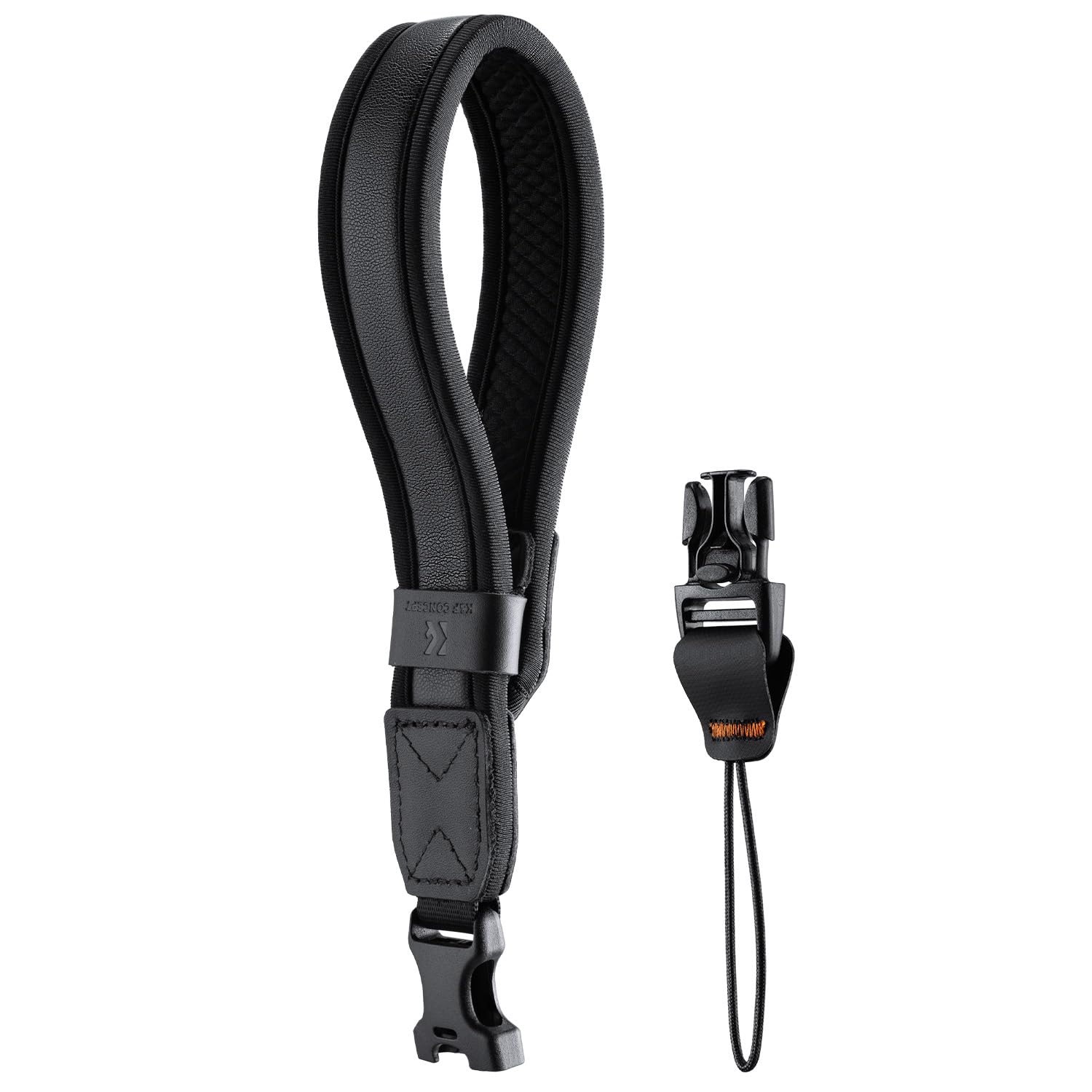
K&F Concept Neoprene Wrist Strap

84 /100
Keeper Score Excellent

Key details

Weight
1.59 oz
Material
Neoprene
Break Strength
99.2 lb
Adjustable Range
27-35 cm
Check Price on Amazon

Forty-five kilograms is an odd figure to print on a wrist strap. It is the cord's break strength, and it means the webbing will not be what lets go; a mirrorless body with a zoom is a couple of kilos, so the number is headroom rather than a working limit. What it cannot tell you is how the buckle behaves after a season, which is the part worth watching.

The material is the real difference. Neoprene is padded and slightly stretchy, so the band sits on the wrist like soft rubber instead of a cord, and at 45 g it is heavier than the rope straps here and far lighter than the plate-mounted hand strap. The quick release comes off in one click, which is the whole point of the design.

The stated adjustment range is 27 to 35 cm, and that is the number we check against a wrist before ordering, because a padded band has less give in the sizing than a cord with a stopper. For travel and hiking, where a soft band against a sweaty wrist beats a thin rope, it is the sensible shape of strap.

Pros

  • Padded neoprene sits softly on the wrist
  • 45 kg break strength
  • One-click quick release

Cons

No notable drawbacks to flag.

Our verdict

Our pick for hiking and travel: a padded neoprene band with a one-click release, as long as the 27 to 35 cm range suits your wrist.

Check Latest Price

How We Tested Camera Wrist Straps

We started with a long list of listings and cut anything whose attachment point looked flimsy in photos, anything that couldn't be adjusted to more than one wrist size, and anything priced out of proportion to what is, at heart, a strip of material and a connector. That left 16 straps in leather, microfiber, neoprene, and rope, which we shot with for four months.

Every strap went onto a real camera and out into ordinary days: a Saturday farmers market, two hikes, a week of daily carry on a mirrorless body with a 35mm lens, and one portrait session with a heavier DSLR rig. We wore each for a full day at a stretch and noted where it sat on the wrist, whether the fit held after we loosened and re-tightened it, and whether we were still thinking about it by hour six.

For security, we loaded each strap with a weight equal to a body plus lens, shook it, and then inspected the stitching, the cord ends, and the spot where material meets hardware. We judged stiffness fresh out of the box and again at the four-week mark to see which ones softened and which stayed board-stiff. Thickness got the pocket test — how much room each took up in a camera bag — and we moved straps between bodies repeatedly, timing each changeover, because a quick-release that costs two minutes every swap isn't quick.

None of this is complicated gear, which is exactly why the differences live in the details: a slightly wider band, a release that needs a deliberate press, leather that ages instead of cracking. We'll keep these in rotation and update if anything gives out.

How to Choose a Camera Wrist Strap

Start With the Lug, Not the Strap

The mount decides everything, so check it first. A round lug hole takes a cord; a slotted lug takes a flat metal loop or a webbing tab; a camera with no usable lug needs a strap that screws into the tripod socket. Measure the hole before you order. The compact strap here uses a 1 mm cord, which is right for a point-and-shoot and far too thin for a mirrorless lug.

If your camera has slotted lugs, look for the metal loop that comes with the SMALLRIG. Round lugs take a cord, which is faster to fit and easier to replace when it wears.

Get the Loop Size Right, Then Test the Cinch

A wrist strap works by being close. If the loop hangs loose you may as well not be wearing it, so the feature that matters is a stopper that slides and stays where you leave it rather than a fixed loop. Sizing is where straps fall down: several here are built around an average wrist and run short on a large hand.

Measure your wrist circumference and compare it with a stated range where one exists. Where none does, treat a strap under about ten inches as a small-to-medium proposition, and look for a cinch that takes up the slack.

Match the Strap to the Camera's Weight

The load varies more than the straps do. A 1 mm cord and 11 g of microfiber is plenty for a compact, while a full-frame body with a 70-200 wants webbing with a stated break strength and a connector that locks. The PGYTECH's 55 kg and the K&F Concept's 45 kg are headroom figures rather than targets, but they tell you the hardware was designed for weight.

A thin rope on a heavy camera won't fail on day one. It just puts the wear on the lug and asks more of a cord than it was made for.

Materials, Comfort and Quick Release

Braided paracord looks the part and starts stiff. Leather softens but goes tacky against bare skin unless it is lined with microfiber, and neoprene is the softest against the wrist and the warmest. Quick release is worth paying for if you move between wrist, neck and sling in one session, but every system is proprietary, so pick the one you will stay in.

If the strap never comes off the camera, a fixed cord is lighter and has one less thing to check before you lift the camera to your eye.

Frequently Asked Questions

Final Verdict

Our pick for a mirrorless camera is the SMALLRIG 3926: the sliding stopper is the feature that makes a wrist strap work, the leather-and-microfiber body stays comfortable, and both mounts come in the box.

Move up to the Peak Design Cuff if you already own anchors or switch between wrist and sling in a session, and to the PGYTECH if your body is heavy enough that a 55 kg rating is the point. Compact shooters should start with the VKO soft strap, and a DSLR with a long lens gets more from the JJC.