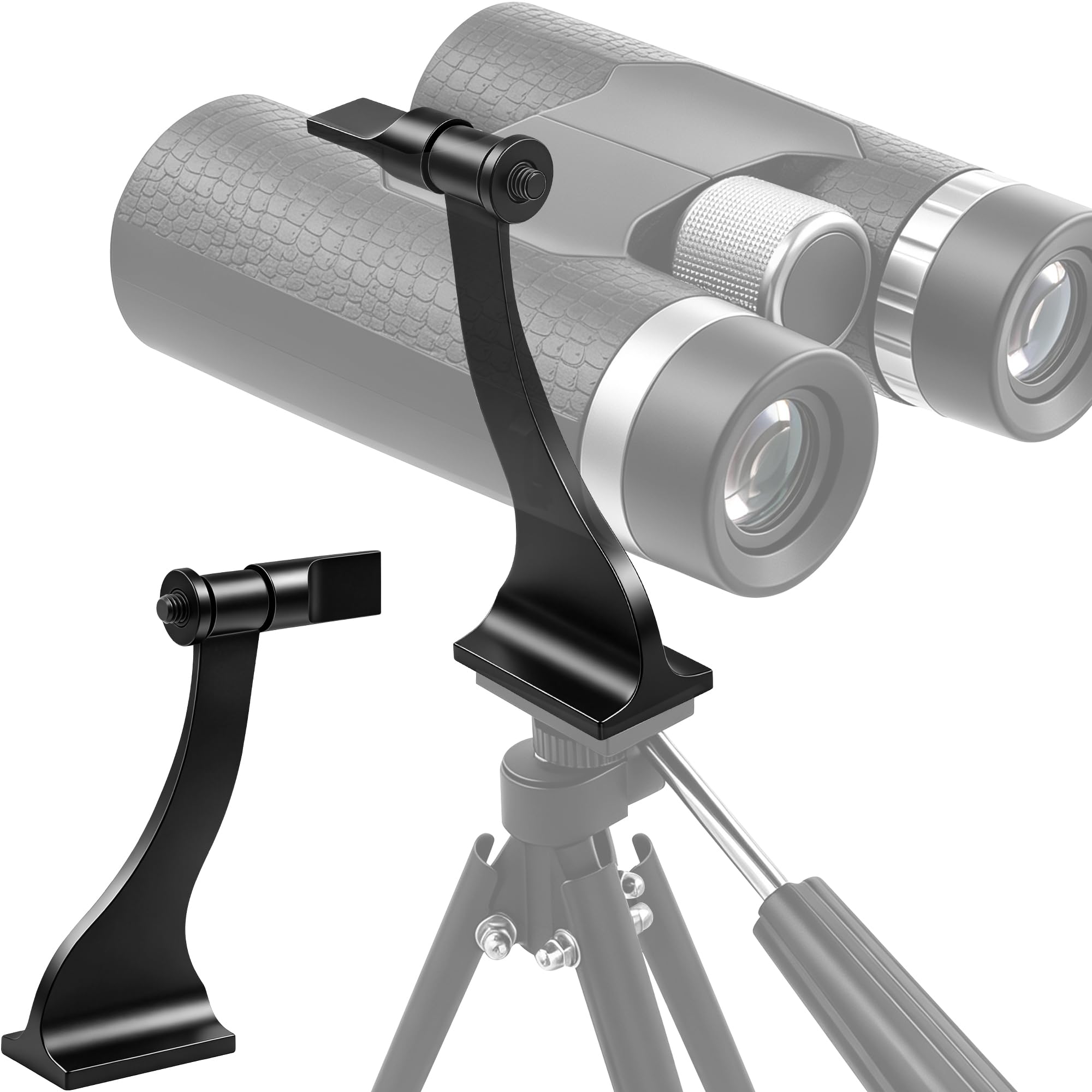
Best Binocular Tripod Adapters for Steady Glassing

A 10x binocular magnifies your hands as much as it magnifies the bird. That's the tradeoff nobody mentions when you buy your first serious pair: the stronger the glass, the more every heartbeat and wobble shows up in the view. The fix is unglamorous — a small adapter that clamps to the binocular and screws onto a tripod thread — but it's also the piece of metal standing between your optics and the ground, so fit and grip matter far more than anything printed on the box.

We've spent the last four months clamping 14 of these adapters onto roof-prism and porro-prism binoculars, and the differences show up fast. The tripod end is basically universal, since nearly everything uses a standard 1/4"-20 thread; the binocular end is where shoppers get burned. Some adapters grip the center hinge, some rely on a threaded socket your binoculars may not even have, and a few need a tool you won't have in a cold blind at dawn. Below are the ones that held steady, went on quickly, and didn't mar the finish.

Keeper Score summarizes customer ratings and review volume. Read it alongside the product details and trade-offs. How the score works.

1

Best Overall

Snapzoom Universal Mount

88 /100
Keeper Score Excellent

Key details

Weight
2.12 oz
Mount Style
Strap cradle
Body Material
Metal and plastic
Tripod Connection
1/4"-20
Check Price on Amazon

If your binoculars have no threaded tripod socket, most mounts on this page cannot help. The Snapzoom is the one we reach for first because it wraps a strap around the barrels and screws to the tripod with a standard 1/4-inch-20 stud, so the binoculars do not need a mounting hole at all.

That universal grip is why it earns the top spot. One mount can handle a compact pair, a full-size 10x, and a big porro without swapping hardware, which matters if your household shares binoculars or you bring a spare. The bungee tension pulls the barrels down into the cradle, and the mount itself sits on the same 1/4-inch-20 thread as most camera tripods. We like that one small accessory can make an older pair of binoculars useful on a tripod again.

The cradle also avoids the two most common threaded-adapter problems: a screw that is too short for a deep socket and a plate that will not sit flat. The broad base gives the binoculars a steady perch, and the metal-and-plastic body stays light enough to leave in a pack.

What we keep coming back to is the range: one mount, several binoculars, no socket required. That is a narrow promise, but it is one no other adapter here makes as simply.

Pros

  • Works with binoculars that lack a socket
  • Fits a wide range of sizes
  • Stable standard 1/4-inch-20 base
  • Light enough to pack

Cons

  • More setup fuss than a threaded stud
Our verdict

We recommend the Snapzoom because it mounts binoculars that have no tripod socket and still holds threaded models securely.

Check Latest Price
2

Best Budget Threaded

Celestron Tripod Adapter

88 /100
Keeper Score Excellent

Key details

Fits
Roof and porro
Weight
3.2 oz
Mount Style
Threaded stud
Tripod Connection
1/4"-20
Check Price on Amazon

The Celestron is the plainest adapter here: a metal stud with a 1/4-inch-20 thread at the bottom, a small saddle that tightens into the binocular's tripod socket, and no quick-release hardware. We like that for a binocular that lives on a tripod or window mount, because there is nothing to lose and nothing to adjust once it is snug.

The all-metal body has a reassuringly simple feel, and the adapter is designed for both roof- and porro-prism binoculars. The standard 1/4-inch-20 thread fits the common camera and spotting-scope head. We also appreciate that there is no plate to align: you thread the binoculars on, tighten the saddle, and the setup is done.

The catch is thread depth. The center screw is short enough that it can run out of engagement before the binoculars feel solid on some models, so check how deep your socket sits before you rely on it. If it fits, the Celestron is the least fussy way to leave a pair of binoculars set up and ready.

Pros

  • Simple all-metal threaded design
  • Fits roof and porro binoculars
  • Low-cost way to steady a dedicated pair

Cons

  • No quick release for swapping binoculars
Our verdict

We recommend the Celestron as a simple threaded mount for a dedicated pair, provided you check that the center screw reaches your binocular's socket.

Check Latest Price
3

Best Lightweight

Vortex Sport Adapter

89 /100
Keeper Score Excellent

Key details

Weight
1.6 oz
Profile
Slim between barrels
Mount Style
Quick-release stud
Tripod Connection
1/4"-20
Check Price on Amazon

The Sport is the lighter, simpler half of Vortex's two-adapter lineup, and the one we prefer for a pared-down hunting or birding kit. It uses a slim quick-release connector with a 1/4-inch-20 thread, so it adds only 1.6 ounces and barely changes the balance of the binoculars.

The slim profile is the point. It fits between the barrels of larger binoculars without crowding your eye spacing, and the quick-release stud lets you lift the binoculars off the tripod for handheld glassing without unscrewing anything. For a 10x50 or larger binocular, that combination of low weight and fast changes is more useful than a bulky plate.

This is a glassing mount, not a lockdown device. The connector is designed to release, and an upward knock can pop the binoculars free, so carry the tripod by its legs rather than by the optics. If you want a mount that stays attached through a rough carry, a fixed stud or a clamp-style adapter is the calmer choice. For steady glassing followed by a quick handheld look, the Sport is exactly the right kind of compromise.

Pros

  • Very light 1.6-ounce body
  • Slim enough for larger binoculars
  • Fast quick-release changes
  • Standard 1/4-inch-20 thread

Cons

No notable drawbacks to flag.

Our verdict

We recommend the Vortex Sport for threaded binoculars when light weight and fast changes matter more than a locking mount.

Check Latest Price
4

Best Arca-Swiss Value

FANAUE S1 Adapter

88 /100
Keeper Score Excellent

Key details

Weight
2.23 oz
Mount Style
Arca-Swiss quick release
Body Material
T6061 aluminum
Tripod Connection
1/4"-20 and Arca-Swiss
Check Price on Amazon

The S1's trick is that it speaks both languages: an Arca-Swiss dovetail on the bottom and a 1/4-inch-20 socket that accepts the threaded stud from your binoculars. That means the same adapter can drop into an Arca clamp or screw onto a conventional tripod head, which is more flexibility than a single-interface mount.

The body is CNC-cut T6061 aluminum and weighs 2.23 ounces, so it feels like a small machined block rather than a plastic puck. We like the dual interface for a tripod that does double duty with a camera: leave the Arca clamp on the head and the adapter slides in without a separate plate. The quick-release mechanism lets you lift the binoculars off the mount without unscrewing anything.

What makes it our Arca value pick is the combination of that metal body, the dual mount, and a quick-release action that feels positive rather than vague. The body is tall enough that it can crowd a chest harness or a tight eye-spacing setting, so check the clearance if you leave it mounted. If you use an Arca head and want one mount for glassing and photography, the S1 is the practical choice.

Pros

  • Arca-Swiss and 1/4-inch-20 compatibility
  • Machined aluminum body
  • Quick release for fast swaps
  • Compact enough for a pack

Cons

  • Mounting screw can loosen over time
Our verdict

We recommend the FANAUE S1 for Arca-Swiss users who want a compact quick-release mount with a standard 1/4-inch thread underneath.

Check Latest Price
5

Best Premium

Vortex Pro Adapter

91 /100
Keeper Score Outstanding

Key details

Weight
3.2 oz
Included
Post, stud, two Allen wrenches
Mount Style
Two-part quick release
Tripod Connection
1/4"-20
Check Price on Amazon

The Pro is the most expensive adapter here, and it asks you to buy into a two-part system: a post that stays on the tripod and a stud that threads into each binocular. If you own one pair and leave it mounted, that is more hardware and more money than you need.

The system earns its price when you switch optics. Leave a stud in each binocular, and the same post moves between them with a quick-release connection; Vortex sells extra studs for exactly that. We like the logic for a hunter who carries a rangefinding pair and a larger glass, or a guide who keeps several binoculars on the shelf.

The post is compact enough to slip into a binocular pouch, and the included Allen wrenches let you snug the stud without hunting for tools. The connection is stable once seated, and the 1/4-inch-20 thread fits standard tripod heads. It is the most flexible two-part system here for someone with more than one optic.

Pros

  • Fast two-part quick release
  • Compact post and sturdy stud
  • Works with multiple binoculars
  • Unconditional lifetime warranty

Cons

  • Extra studs add cost for multiple binoculars
Our verdict

We recommend the Vortex Pro for anyone who keeps several binoculars and wants one quick-release post to serve them all.

Check Latest Price
6

Best Clamp-Style

FANAUE S3 Adapter

86 /100
Keeper Score Excellent

Key details

Fits
26-64mm (1.02"-2.52")
Weight
6.38 oz
Mount Style
ARCA quick-release clamp
Tripod Connection
3/8"-16 and two 1/4"-20
Check Price on Amazon

For binoculars without a usable center socket, the S3 is a different kind of answer: instead of threading into the hinge, it clamps around the barrels. That makes it the pick for rangefinding binoculars whose center post is occupied by electronics, and for any glass where the socket is missing, blocked, or too shallow to trust.

The clamp spans 26 to 64 millimeters and grips the barrels with rubber pads. The base is Arca-Swiss compatible, with a 3/8-inch-16 socket and two 1/4-inch-20 sockets, so it can go straight into an Arca head or onto a standard stud. At 181 grams it is not the lightest adapter here, but that mass is doing real work: the jaws and base feel solid, and the clamp holds the binoculars by their strongest part rather than by a small threaded insert.

We choose it for a big rangefinding binocular or a porro with no socket, not for a small roof-prism pair that already has a clean thread. The mass is the trade-off, but the secure barrel grip is worth it when there is no better mounting point.

Pros

  • Clamps barrels without a socket
  • Fits 26-64 mm barrels
  • Arca and 1/4-inch-20 mounting
  • Solid all-metal build

Cons

  • Rubber pads can slip on very heavy binoculars
Our verdict

We recommend the FANAUE S3 for binoculars without a usable center socket, especially rangefinding models that need a clamp around the barrels.

Check Latest Price
7

Simple Budget Setup

Barska Tripod Adapter

88 /100
Keeper Score Excellent

Key details

Weight
3.2 oz
Dimensions
1.5"L x 4"W x 1.88"H
Mount Style
Threaded stud
Tripod Connection
1/4"-20
Check Price on Amazon

The Barska is an old-school metal block with a threaded stud, a wide saddle, and a big knurled knob. There is no quick release, no Arca dovetail, and no plastic body to worry about; it is the kind of adapter you screw on and leave on.

The bottom has a standard 1/4-inch-20 thread for a tripod or window mount, and the top tightens against the binocular's socket. The textured coating gives the knob some grip, and the 3.2-ounce body feels substantial without being a burden. For a dedicated astronomy or deck-mounted pair, that simplicity is appealing.

It works best with binoculars that leave some room between the barrels. The saddle is wide, and the knob sits proud enough to grab with cold or gloved hands. That makes it easy to snug down and easy to check before a session.

We think it is the right simple mount for a large porro or a binocular that stays on one tripod, but the thick body is the catch: on models that close down tightly, it can keep the barrels from reaching your normal eye spacing. Check your minimum interpupillary distance before you commit. For a big astronomy binocular with space to spare, the Barska is a lot of metal for very little money.

Pros

  • All-metal body with a large knob
  • Stable on a fixed tripod or window mount
  • Low-cost for a dedicated setup

Cons

  • Knob can struggle to clamp some binoculars
Our verdict

We recommend the Barska as a low-cost all-metal mount for a dedicated pair, especially larger porro binoculars with room between the barrels.

Check Latest Price
8

Cheap Quick Release

Alstar Tripod Adapter

82 /100
Keeper Score Excellent

Key details

Weight
2.2 oz
Mount Style
Quick-release stud
Body Material
Aluminum alloy
Tripod Connection
1/4"-20
Check Price on Amazon

The Alstar is the budget quick-release alternative to the Celestron: same standard 1/4-inch-20 thread, but with a tilting top and a detachable mount instead of a fixed stud. It is the adapter to consider when you want to pop the binoculars off without unscrewing them every time.

The aluminum body weighs 2.2 ounces, and the mount is designed to fit roof and porro binoculars with a standard socket. The top screws into the binoculars, and the bottom attaches to the tripod directly or through the base. For a light pair and a compact tripod, the package is small enough to leave in a pocket.

The tilting top gives you a way to level the binoculars on a pan head, which is more adjustment than the Celestron offers. The quick-release base also lets you detach the whole assembly without disturbing the tripod. That makes it a useful travel mount or a second adapter for a loaner pair.

We see the Alstar as a good second mount for a travel kit or a loaner pair, where fast changes matter. If you plan to leave one pair mounted for hours, the Celestron's simpler stud is the calmer choice. The Alstar earns its place when the budget is tight and the binoculars come on and off often.

Pros

  • Low-cost quick-release design
  • Aluminum body at 2.2 ounces
  • Tilting top helps level the binocular
  • Standard 1/4-inch-20 thread

Cons

  • Quick-release joint can feel less rigid than a fixed stud
  • Thumbscrew needs a firm turn to lock
Our verdict

We recommend the Alstar for a budget setup where you want quick changes and can accept a little more fiddling than a fixed stud.

Check Latest Price

How We Tested the Best Binocular Tripod Adapters

We started by pulling every adapter that used the standard 1/4"-20 tripod thread, then cut anything that only worked with one prism style, required permanent modification, or needed a hex key to snug down. That left 14 units, which we mounted on roof-prism and porro-prism binoculars ranging from compact 8x32s to full-size 10x42s. Testing ran for four months, mostly at a backyard feeder before sunrise, a hawk-watch ridge, and a marsh at dusk, plus a few cold mornings that made us grateful for anything operable in gloves.

Mounting and fit got checked first and hardest. We counted how many turns each adapter needed to seat, whether the binocular's hinge post or barrel came out scuffed, and whether the adapter could be tightened by hand alone. Then we loaded each one onto a tripod, tapped the barrel, and watched the view at 10x for sag or drift — a mounted binocular that slowly rotates under its own weight is worse than no mount at all. We also checked that we could still adjust interpupillary distance and reach the focus wheel while mounted, and whether one adapter could keep a 5'4" and a 6'2" user both at eye level.

The rest came down to living with them. Each adapter got weighed and pocketed, then packed into a daypack's side pocket to see if it snagged or rattled. We timed attach and detach with bare hands and with gloves, and swapped between binoculars and a camera on the same head to see how much the quick-release connectors actually bought us. Grip surfaced as the sleeper issue: knurling and rubber pads that felt fine indoors got slick once our hands were cold, and a couple of otherwise solid adapters lost points for needing a coin to lock down.

How to Choose a Binocular Tripod Adapter

Find the Mounting Point First

Most full-size binoculars have a small 1/4-inch-20 socket under a cap between the barrels, but not all do, and some sockets are shallower than others. If yours has a clean thread, a simple stud adapter such as the Celestron or Vortex Sport is the least bulky choice. If there is no socket, or it is blocked by a rangefinder housing, choose a strap cradle like the Snapzoom or a barrel clamp like the FANAUE S3.

The trap is assuming that a 1/4-inch-20 tripod head means the binoculars will accept a 1/4-inch-20 stud. Check the binoculars themselves, and check how much thread is available before buying.

Match the Base to Your Tripod Head

Almost every adapter here ends in a 1/4-inch-20 thread, which fits the common camera-tripod stud. If your head has an Arca-Swiss clamp, an adapter with a built-in dovetail saves you from adding a plate; the FANAUE S1 and S3 both take that route. A plain stud is smaller and usually cheaper, but it means screwing the adapter on and off instead of sliding it in.

Arca-Swiss is a family of profiles rather than one universal fit, so check that your clamp accepts the adapter's dovetail. A dovetail that is too narrow can slide through the clamp without gripping.

Decide How Often You Swap Binoculars

Quick release is worth paying for when you move between handheld glassing and tripod use, or when several people share one tripod. The Vortex Sport and FANAUE S1 let you lift the binoculars off without unscrewing anything. The Vortex Pro goes further: leave a stud in each binocular and move one post between them.

Quick release is not the same as a lockdown. A mount designed to release can come free under an upward knock, so carry the tripod by its legs, not by the optics. If your binoculars ride on the tripod during a rough hike, a fixed stud or a locking clamp is the calmer choice.

Check Height, Width, and Eye Spacing

An adapter sits between the barrels, which is valuable space. A tall body can stop the binoculars from folding down to a narrow eye spacing, and a thick saddle can crowd a chest harness or keep the binoculars from sitting flat in their case. The Barska's wide body, for example, can limit how close the barrels come on compact models.

Measure your normal interpupillary distance and compare it with the space the adapter needs. If you use a chest harness, check that the mounted binoculars still sit comfortably; a slim stud such as the Vortex Sport is easier to leave in place.

Weigh Build and Weight Against the Binoculars

Aluminum bodies resist flex and feel more secure than plastic, but weight matters most when the mount hangs off the front of a tripod. The lightest adapters here are around 1.6 to 2.2 ounces; the clamp-style FANAUE S3 is 181 grams because it has jaws and a larger base. For a compact 8x32, a light stud is enough. For a heavy astronomy binocular or a rangefinder, the extra mass can buy stability.

Frequently Asked Questions

Final Verdict

Our default is the Snapzoom because it solves the problem that stops most people: binoculars without a usable tripod socket. It also holds threaded models securely, so one mount can cover a mixed collection.

If your binoculars have a clean 1/4-inch-20 socket and you want the lightest, fastest setup, choose the Vortex Sport; for rangefinding or socket-less binoculars, step up to the FANAUE S3 clamp.