Best Bench Power Supplies of 2026

A bench power supply does one job — it takes wall power and hands it back at whatever voltage and current you dial in. The difference between a good one and a maddening one lives in the gap between what the display promises and what the terminals deliver. Get that wrong and you're the person who cooked a new board at 3.3 volts, or spent an afternoon chasing a flicker that turned out to be ripple.

We've had 12 of them on the bench over the past seven months, from compact switching units to heavy lab-grade linear supplies. The headline amp number turns out to be the least interesting figure on the listing; what separates them is how the coarse and fine knobs behave when you're hunting for exactly 3.30V, how clean the output stays at full load, and whether the fan gets annoying.

The tradeoff here is real, not marketing: linear supplies run silent and clean but heavy and hot, switching supplies run cool and light but ask more of their filtering. There's a fit for either camp below.

Keeper Score summarizes customer ratings and review volume. Read it alongside the product details and trade-offs. How the score works.

1

Best Overall

WANPTEK DPS3010U

90 /100
Keeper Score Outstanding

Key details

Ports
USB and Type-C
Output
0-30V, 0-10A
Controls
Encoder coarse and fine
Max Power
300W
Check Price on Amazon

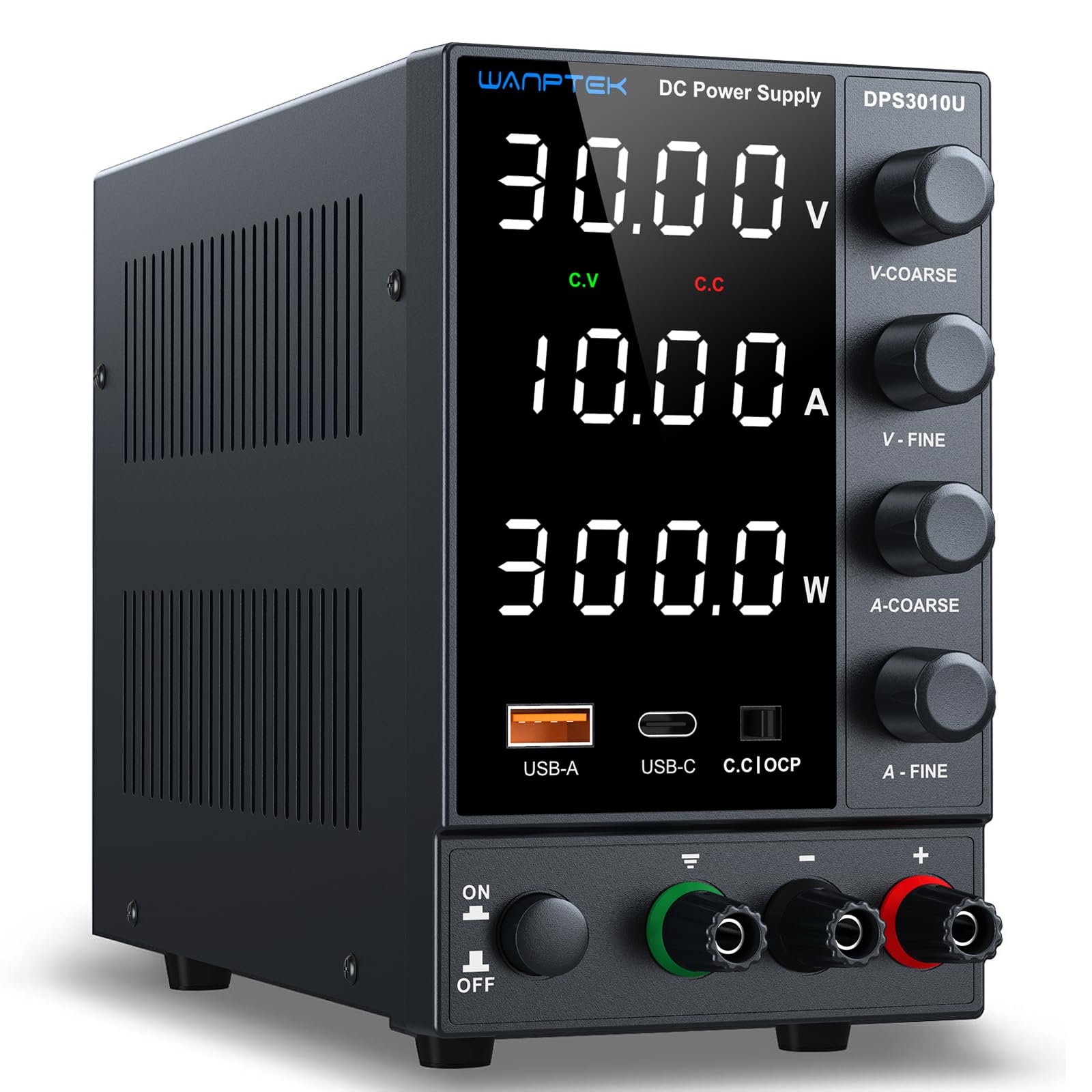
The two encoder knobs on the WANPTEK DPS3010U are the reason it became the supply we keep closest to the meter. Instead of turning a potentiometer and watching the display drift, you press the knob to pick volts or amps, then rotate to change the digit. Coarse and fine tuning live on the same control, so moving from 5V to 12V is quick, and nudging 3.3V to 3.35V does not feel like a gamble.

The envelope is the one most electronics benches actually use: 0-30V, 0-10A, and 300W, with a 4-digit display that reads to 0.01V and 0.001A. We found that combination covers breadboard rails, motors, car stereos, and the occasional battery top-up without making you choose between voltage and current too early. At 2.6 pounds, it also stays put on a shelf instead of claiming a permanent corner of the bench.

Protection is where this one earns trust: overcurrent protection stops the output and a short-circuit alarm sounds when leads touch. We also appreciate the USB and Type-C charging ports, which keep a phone or test device charged without another wall wart. The trade-off is that this is a switching supply, not a linear one, so it is the generalist rather than the quietest choice for sensitive analog work. For most repair and digital projects, that is the right compromise.

Pros

  • Encoder coarse and fine adjustment
  • 0-30V, 0-10A, 300W output
  • OCP and short-circuit alarm
  • USB and Type-C charging ports

Cons

  • Switching supply, not linear
Our verdict

We recommend the WANPTEK DPS3010U as the best all-around bench supply here: encoder control, 30V/10A headroom, and real protection in a compact case.
Check Latest Price
2

Best for Multi-Rail Work

Siglent SPD3303X-E

89 /100
Keeper Score Excellent

Key details

Design
Linear, programmable
Outputs
Three isolated
Channels
32V/3.2A x2, 2.5V/3.3V/5V/3.2A x1
Max Power
220W
Check Price on Amazon

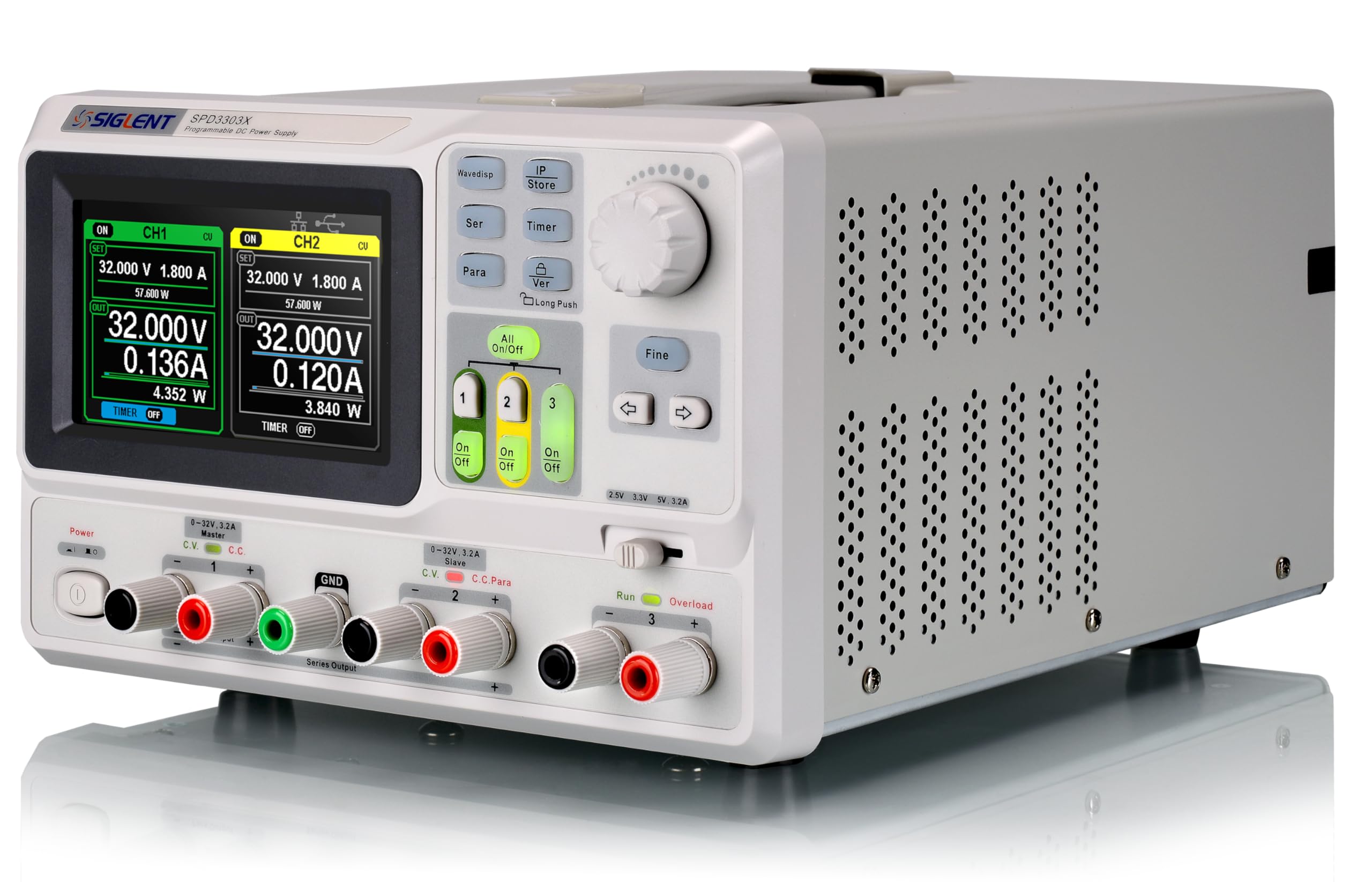
Three isolated outputs is the spec that changes how a bench gets used. The Siglent SPD3303X-E gives you two 32V/3.2A channels plus a third output that switches between 2.5V, 3.3V, and 5V at 3.2A. We like being able to power a circuit and its logic rail at the same time, then tie the two main channels in series or parallel when a job needs more voltage or current.

It is a linear supply, which is why the case weighs 17.6 pounds and why it belongs on a permanent bench rather than a shelf you rearrange. The payoff is the kind of clean, low-noise power that analog and mixed-signal work benefits from, and the programmable settings make repeatable tests easier than dialing two knobs by eye. The third output is not a full third variable channel—it is a fixed-selectable rail—so plan around that if you need three independent adjustable supplies.

The interface is the part we had to adjust to. Menus and button presses take longer than a knob-only supply when you are making a quick change, and the display logic is not instantly obvious. Once the settings are in, though, the individual output controls and the clear main display make it easy to see what is live. For a lab that needs multiple rails and repeatable settings, that trade is worth it; for a one-off repair bench, it is more supply than you need.

Pros

  • Three isolated outputs
  • Two 32V/3.2A channels
  • Programmable, series and parallel modes
  • Linear design

Cons

  • Third output is fixed-selectable, not adjustable
  • 17.6 lb and a large footprint
Our verdict

We recommend the Siglent when one bench needs two adjustable rails plus a logic supply, and you value programmable repeatability over a simple knob layout.

Check Latest Price
3

Best Linear Supply

KORAD KD3005D

87 /100
Keeper Score Excellent

Key details

Design
Linear
Output
0-30V, 0-5A
Weight
9 lb
Display
Dual 4-digit LED
Check Price on Amazon

The KORAD KD3005D feels like lab equipment: a metal case, 9 pounds of transformer, and a pair of 4-digit LED displays that are easy to read across the bench. That heft is the point. The linear design is why we reach for it over the lighter switching supplies here when the job is clean power for audio, sensors, or low-level analog work.

The range is 0-30V and 0-5A, with over-load, short-circuit, and over-temperature protection and a switchable 110/220V input. The fine adjustment is the part we trust: it is easy to set a low voltage precisely and watch the current limit engage. The 5A ceiling is the honest limit—if you need to run motors or high-current loads near 10A, this is not the supply. The automatic mA/A display change is a small convenience we came to rely on.

The controls are simple in a way that suits a bench: separate voltage and current knobs, a lock function, and a display that stays readable in room light. We did not miss a menu, and we liked that the current limit can be set before connecting a load. It is the kind of supply you can leave set up and return to without re-learning it.

Pros

  • Linear design for clean power
  • Fine voltage and current adjustment
  • Dual 4-digit LED displays
  • Metal case and 9 lb build

Cons

  • 5A maximum limits high-current work
  • Heavy and bulky for a small bench
Our verdict

We choose the KORAD when linear power and fine low-voltage control matter more than current headroom, and the 5A ceiling fits your work.

Check Latest Price
4

Best for Beginners

Kungber SPS3010B

90 /100
Keeper Score Outstanding

Key details

Output
0-30V, 0-10A
Weight
2.3 lb
Controls
Coarse and fine potentiometers
Max Power
300W
Check Price on Amazon

The Kungber SPS3010B is the supply we hand to someone who has never used a bench supply before. The controls are ordinary potentiometers—coarse and fine for voltage and current—so there is no menu to learn and no digit to select. Turn the knob, watch the display, and the output follows. For a beginner, that familiarity is worth more than a fancy encoder.

It covers 0-30V and 0-10A, with a 300W ceiling, a 2.3-pound body, and an 18W USB port. We were surprised by the charging mode, which shows the charging energy in Ah rather than just volts and amps; that is a genuinely useful touch for battery work. Overcurrent detection and a short-circuit alarm are there too, and the compact case leaves room for a meter and a breadboard.

The caveat is longevity. The controls are less repeatable than an encoder, and the reliability picture is mixed enough that we do not treat this as a buy-and-forget lab instrument. Some units have failed on first use, and others after months of occasional use. That does not erase the value for hobby work, but it does mean you should test it under load early and keep the return window handy.

Pros

  • Simple coarse and fine potentiometers
  • 0-30V, 0-10A, 300W
  • 18W USB port and charging mode
  • Overcurrent detection and short alarm

Cons

  • Long-term reliability is the open question
Our verdict

We recommend the Kungber as a friendly first supply for hobbyists who want 30V/10A and simple knobs, provided they test it early.

Check Latest Price
5

Tight Bench Spaces

NICE-POWER SPS-C3010

90 /100
Keeper Score Outstanding

Key details

Ports
5V/2A USB
Output
0-30V, 0-10A
Display
4-digit LED
Max Power
300W
Check Price on Amazon

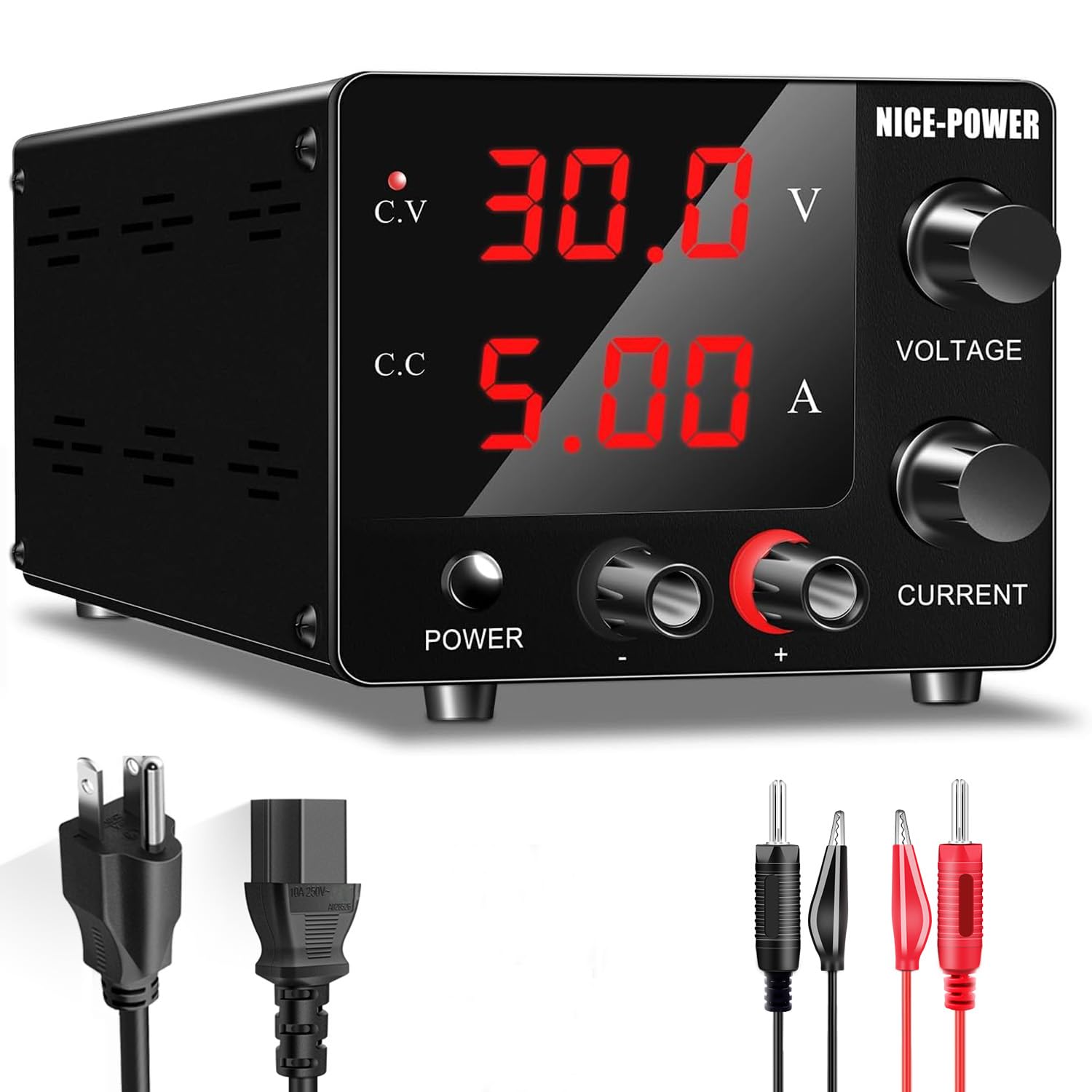
The NICE-POWER SPS-C3010 leads with a feature that sounds minor until you use it: a dedicated output switch. You can set voltage and current with the load connected, check the display, and then apply power without unplugging anything. The vertical case is the other practical detail—3.3 inches wide, 8.4 inches deep, and 5.5 inches tall—so it fits beside a meter instead of spreading across the bench.

The headline is a full 0-30V, 0-10A, 300W envelope, with a 4-digit LED display and a 5V/2A USB port. That is the same working range as the top pick, and for basic repair, electroplating, and breadboard work it is more than enough. At 2.6 pounds it is easy to move, and the display is readable from a sitting position.

The coarse and fine knobs are where it gives ground. At low settings they can feel twitchy, and the current control is less confidence-inspiring than the voltage side. We found ourselves making a small adjustment, checking the meter, and adjusting again—workable, but not the set-and-forget feel of an encoder. The output switch helps because you can set the limits before applying power, but it does not fix the feel of the knobs.

Where this one earns its place is value: it gives you the full 30V/10A range, a useful output switch, and a small footprint at a budget price. We choose it for a second bench or a tight budget, not as the supply we rely on for every precise low-voltage job. If most of your work is digital and you set 5V or 12V more often than 1.8V, the trade is easy to live with.

Pros

  • Output switch sets power before load
  • 0-30V, 0-10A, 300W
  • 4-digit LED display
  • Compact vertical footprint

Cons

  • Switching design, not linear
Our verdict

We recommend the NICE-POWER SPS-C3010 as a budget 30V/10A supply with a genuinely useful output switch for a second bench.

Check Latest Price
6

Small Low-Power Jobs

NICE-POWER SPS-E305

89 /100
Keeper Score Excellent

Key details

Output
0-30V, 0-5A
Display
3-digit LED
Max Power
150W
Dimensions
6.5 x 4 x 3.2 in
Check Price on Amazon

At roughly 6.5 by 4 by 3.2 inches, the NICE-POWER SPS-E305 is the supply that can live in a drawer and come out for a small job. We kept it on a shelf above the bench and barely noticed it was there until we needed 5V for a sensor or 12V for a small fan. That is a different kind of convenience from a full-size bench supply: you do not have to clear a permanent space for it.

It covers 0-30V and 0-5A, with a 150W ceiling, a 3-digit display that resolves 0.1V and 0.01A, and an encoder knob for setting digits. The resolution is coarser than the 4-digit units here, so it is not the one for millivolt-level work; but for electroplating, LED tests, and low-power breadboards, it is enough. The 5A ceiling is the other limit—fine for small electronics, not for a motor that wants a short burst of 10A. We treat it as a specialist, not the only supply on a serious bench.

The package includes the supply, power cord, output load cord, and manual, so you can use it without hunting for leads. We keep it for sensor tests, small fans, LED strings, and electroplating setups where 5A is plenty. It is not the supply for a repair bench that regularly needs 10A or four-digit resolution, but it is a useful second unit for the jobs that do not justify clearing space for the big one.

Pros

  • Compact 6.5 x 4 x 3.2 inch body
  • 0-30V, 0-5A, 150W
  • Encoder digit selection

Cons

  • 3-digit display limits fine resolution
  • Fan runs continuously
Our verdict

We recommend the NICE-POWER SPS-E305 for small, low-power jobs where a compact 30V/5A supply and a 150W ceiling are enough.

Check Latest Price
7

Higher-Voltage Projects

Jesverty SPS-6005

81 /100
Keeper Score Excellent

Key details

Ports
5V/2A USB
Output
0-60V, 0-5A
Weight
Approx. 2.5 lb
Display
4-digit LED
Check Price on Amazon

The 60V ceiling is what earns the Jesverty SPS-6005 a place here. Most of the supplies on this page stop at 30V, which is fine until you need to test a 48V rail, a higher-voltage module, or a stack of series cells. The SPS-6005 keeps the same compact case and 4-digit display as the 30V Jesverty, but adds the higher-voltage range. We see that as a fair swap for the buyer who keeps running into the 30V wall.

It also has a 5V/2A USB port, coarse and fine adjustment, and a 2.5-pound body, so it fits the same shelf as the rest. The controls are the same layout as the 30V version, and the display is easy to read at a glance. If your bench rarely goes above 24V, the 30V/10A units give you more current for the same money. If 48V is normal, this is the one that keeps you from stacking supplies.

We also appreciate that it does not force a new workflow: the same coarse and fine knobs, the same four-digit readout, and the same USB convenience as the smaller Jesverty. That consistency matters when you are switching between projects. It is a specialist, not the default for general repair.

Pros

  • 0-60V, 0-5A range
  • 4-digit LED display
  • 5V/2A USB port
  • Compact 2.5 lb body

Cons

  • 5A ceiling limits high-current 48V loads
Our verdict

We recommend the Jesverty SPS-6005 for 48V and other higher-voltage work, where its 60V range matters more than the 5A ceiling.

Check Latest Price
8

Travel Bench Kit

FNIRSI DPS-150

86 /100
Keeper Score Excellent

Key details

Input
PD/QC/DC, no adapter
Output
0-30V, 0-5A
Ripple
<20mV
Max Power
150W
Check Price on Amazon

The FNIRSI DPS-150 is not a conventional bench supply, and the missing power adapter is the first clue. It is a 150W buck regulator that can take power from USB-C PD, QC, or a DC source, then output 0-30V and 0-5A through banana jacks or the supplied alligator leads. At 6.24 ounces and roughly 4 by 3 by 1.2 inches, it is the only one here that disappears into a laptop bag.

The catch is that a buck regulator cannot output more than its input. With a common 20V USB-C PD source, you will not see the full 30V; the ceiling is real. To reach the top of the range you need a higher-voltage DC input, and the required adapter is not in the box. We treat the 30V/5A label as the ceiling with the right source, not a promise from a phone charger.

What it does well is portability and clean output for its size. The rated ripple is under 20mV, the 2.8-inch IPS display flips 90 degrees for viewing from either side, and the PC software stores six output presets. The 4mm banana jacks, U-shaped terminals, and fine copper wire connections give you more ways to hook it up than the usual binding posts. For field work or a small travel kit, that is a useful combination.

We do not make it the main supply on a repair bench. The 5A/150W ceiling is modest, the input limitation changes what you can do, and the tiny body leaves no room for the inertia of a full-size unit. But as a second supply for low-voltage checks, or a travel kit for someone who already owns a 24V or 30V DC source, it earns its place. The flip display is the detail we did not expect to use as often as we did.

Pros

  • 6.24 oz and pocketable
  • Under 20mV ripple
  • PC presets and flip display
  • PD/QC/DC input

Cons

  • No power adapter included
  • Output limited by input voltage
Our verdict

We recommend the FNIRSI DPS-150 as a travel or secondary supply for low-voltage work, provided you have a suitable high-voltage DC source and do not need 10A.

Check Latest Price

How We Tested Bench Power Supplies

The shortlist came out of months of spec sheets and owner threads, filtering for genuinely variable output, real current limiting, and displays that read to at least three decimals. Anything with a fixed 5V rail or a coarse-only knob got cut early. That left 12 units, which we bought ourselves and ran on real benches — a home electronics desk, a repair tech's workbench, and a garage setup where electroplating and battery charging actually happen.

Over seven months they powered microcontroller boards, LED strips, small motors, and battery packs on slow charge cycles. We compared every display against a calibrated meter at 5V, 12V, and each unit's ceiling, then left it loaded for an hour to see how far the readout drifted. A scope and a resistive load bank handled ripple at half load and at full load.

We dialed the coarse knob straight at 5V to see how far past it we overshot, then finished with the fine knob and counted the turns — the units that landed within a hundredth were the ones we stopped thinking about. To judge current control, we shorted the outputs on purpose and watched whether the supply folded back smoothly or just cut out, and whether the output switch killed the terminals without losing our settings. Each unit also ran at its rated maximum long enough for the fan to ramp, so we could hear it over a conversation. Front USB and USB-C ports got a phone and a wireless mouse, and value got the last word: what a unit cost relative to the accuracy and quiet it actually delivered.

How to Choose a Bench Power Supply

Match the Output to the Work, Not the Label

A 30V/10A unit covers most low-voltage electronics: breadboard rails, small motors, relays, audio boards, and repair work. If you work on 48V rails or higher-voltage modules, a 60V/5A supply such as the Jesverty SPS-6005 keeps you from stacking supplies. The wattage rating matters too, because 30V and 10A are the top corner of the range, not a promise that the unit can sit there continuously.

Write down the highest voltage and the highest current you need separately, then check them together. A supply that reaches 30V and 10A may not deliver both at once. If your work is mostly 3.3V, 5V, and 12V, current headroom usually matters more than a higher voltage ceiling.

Controls Decide Whether You Reach for It

An encoder lets you select a digit and turn to change it, which makes repeatable settings easier. A potentiometer is faster to sweep but harder to return to exactly 1.8V or 3.35V. Coarse and fine knobs can close that gap, but the fine control needs to feel usable at the low end, not just at 12V.

If you set the same rails again and again, prioritise an encoder like the one on the WANPTEK DPS3010U. If you mostly sweep voltage while watching a meter, the simpler potentiometers on the Kungber SPS3010B are familiar and quick. Either way, check the current-limit knob as carefully as the voltage knob; that is the control that protects the circuit.

Protection and Output Switching

Overcurrent protection and a short-circuit alarm are not substitutes for careful probing, but they save parts and fuses when a lead slips. An output switch is the other feature worth paying for: you can set voltage and current with the circuit connected, check the display, and then apply power. The NICE-POWER SPS-C3010 makes that switch a headline feature, and the Siglent gives each output its own on/off control.

For repair work, look for a supply that can stop output without unplugging the load. For general tinkering, overcurrent protection is enough. Do not assume every unit has both features just because it has a digital display.

Linear or Switching?

Linear supplies are heavier, less efficient, and usually cleaner electrically. That is why the KORAD KD3005D weighs 9 pounds and the Siglent SPD3303X-E weighs 17.6 pounds. For audio, sensors, RF, or low-level analog work, that trade is often worth it. Switching supplies are lighter and more compact, which is why the WANPTEK and most budget units fit on a shelf.

Choose linear when low ripple and stable low-voltage output matter more than weight or current headroom. Choose switching for digital repair, motors, electroplating, and general bench work where a compact 30V/10A envelope is more useful than a heavy transformer.

Bench Space, Portability, and Output Count

A 2.3-pound unit can live on a shelf and come out for a job; a 17.6-pound linear supply wants a permanent home. If you need three rails, a triple-output supply replaces three boxes and the cable mess between them. If you need to carry a supply to a job site, check the input requirements before you buy: the FNIRSI DPS-150 is tiny, but it does not include a power adapter and cannot reach 30V from a common 20V USB-C source.

Count the outputs you actually use, not the ones you might use someday. Two adjustable channels plus a fixed logic rail is a different tool from a single 30V/10A supply, and it costs and weighs accordingly.

Frequently Asked Questions

Final Verdict

We recommend the WANPTEK DPS3010U as the supply to buy first for most electronics benches. It has the 30V/10A range, encoder controls that make settings repeatable, and protection that matters when a probe slips, all in a 2.6-pound case.

If you need multiple rails, the Siglent SPD3303X-E is the better bench companion. If clean linear power matters more than current headroom, choose the KORAD KD3005D. The rest of the list is for specific constraints: higher voltage, a tiny footprint, or a tight budget.