Best APS-C Compact Cameras of 2026

Every time I tell someone to buy a small camera, they ask the same question: isn't my phone good enough? For plenty of shots, honestly, yes. But a phone can't give you a sensor several times larger, a lens with real glass, or autofocus that holds a running kid instead of hunting for him. What this category buys you is near-DSLR image quality in something you'll actually carry.

The catch is that "small" means very different things here. Over the past eight months, we've shot with six cameras in this class, from fixed-lens models that slip into a jeans pocket to interchangeable-lens bodies that are compact only next to a DSLR. What separates them has less to do with megapixels than with autofocus in bad light, how the controls fall under your thumb, and what's actually in the box for the money.

Battery life and heat are the unglamorous deciding factors: a camera that dies before dinner or shuts off mid-clip is one you leave at home. The six below survived real weekends, and they're sorted by who each one suits.

Keeper Score summarizes customer ratings and review volume. Read it alongside the product details and trade-offs. How the score works.

1

Best Overall

Sony Alpha a6400

91 /100
Keeper Score Outstanding

Key details

Sensor
APS-C CMOS
Weight
1.1 lb
Autofocus
425 phase-detection points
Viewfinder
Electronic, 1.07x
Check Price on Amazon

Four hundred and twenty-five phase-detection points spread across most of the frame is the number that explains the a6400. It means the camera can find and hold an eye near the edge of the picture, not just in the middle, so you can compose off-center and still get a sharp face. We shot bursts of people walking toward us and the hit rate was the best of anything in this group. An 11 fps burst and a screen that tilts up for waist-level work make that kind of shooting easy to keep up with.

The body is the other half of the argument, and it is the half that kept us picking it up. At about a pound with the 16-50mm zoom fitted it drops into a small shoulder bag, and there is a real electronic viewfinder for bright afternoons — the thing we missed most on the screen-only cameras here. Sony's E-mount is the deepest of the mounts in this group, so the a6400 can start as a one-lens camera and end up as a system you keep adding to.

What you give up is in-body stabilization. Steadiness comes from the lens, and the kit zoom has it, so handheld daylight shots are fine; fit an unstabilized prime and you will want to keep shutter speeds up once the light drops, which is exactly the gap the a6700 fills. The kit zoom is the usual compromise too — it collapses small, then turns slow at the long end. Neither is a reason to walk away; both are reasons to know what your second lens is for.

Pros

  • Real-time eye autofocus that holds on moving subjects
  • Compact, light body with a built-in viewfinder
  • Deepest native lens selection of the picks here
  • 4K video and 11 fps bursts

Cons

  • Battery life falls short of a full day
  • Screen tilts but does not swing out sideways
Our verdict

We recommend the a6400 as the default compact APS-C camera: the surest autofocus here, a viewfinder, and a lens mount worth growing into.
Check Latest Price
2

Best for Beginners

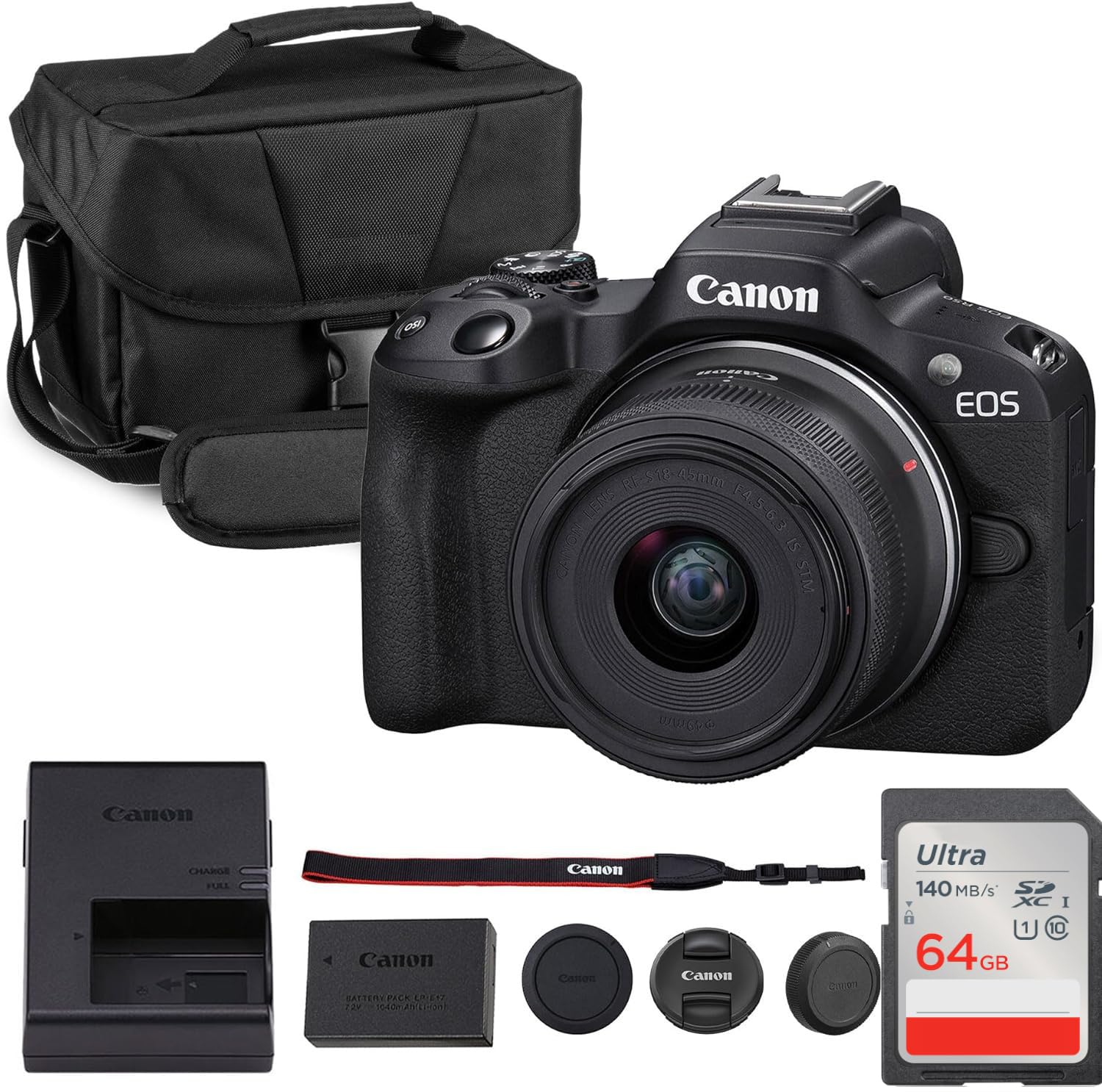
Canon EOS R50

91 /100
Keeper Score Outstanding

Key details

Video
4K oversampled
Sensor
24.2MP APS-C
Autofocus
Dual Pixel CMOS AF II
Viewfinder
Electronic
Check Price on Amazon

Most first cameras are bought by people who want pictures, not a project. The R50 is built for that buyer: menus that lead with plain settings, on-screen explanations of what each one does, and a Creative Assist mode that hands you brightness and background blur as sliders instead of exposure theory. It is the least intimidating camera here, and the only one whose box included a memory card and a bag as well as the lens — worth knowing if you are starting from nothing.

Under the hand-holding sits a 24.2MP APS-C sensor and Canon's Dual Pixel AF II, with eye detection that holds on faces and pets rather than drifting between them. The 18-45mm kit lens collapses flat enough that the whole camera drops into a small sling, and the electronic viewfinder means you can frame it in bright sun without shading the screen with your hand. Video is oversampled 4K, which looks better than its resolution figure suggests.

We recommend it as the easiest first camera in this group, and the one whose autofocus flatters a beginner instead of punishing them. The catch is the glass: f/4.5-6.3 is dim once the sun goes, and indoor shots push the ISO up quickly. Plan on a fast prime, or accept that this is a daylight camera first. It is also not weather-sealed, so a rainy trip means a dry bag.

Pros

  • Simplest menus and setup in this group
  • Eye-detect autofocus that holds its subject
  • Small body with a real viewfinder
  • Bundle includes a memory card and bag

Cons

  • Kit lens is slow indoors and in the evening
  • Not weather-sealed
Our verdict

Buy the R50 as a first interchangeable-lens camera: guided menus, dependable eye autofocus and a viewfinder, with a kit lens that wants daylight.

Check Latest Price
3

Best Budget

Canon EOS R100

90 /100
Keeper Score Outstanding

Key details

Video
4K at 24p
Sensor
24.1MP APS-C
Display
3-inch fixed
Autofocus
Dual Pixel CMOS AF, 143 zones
Check Price on Amazon

The R100 is the least expensive way into an APS-C sensor here, and Canon kept the two things that matter most at this end: the 24.1MP sensor itself and an electronic viewfinder. On a bright afternoon that finder is the difference between a camera you can use and one you are guessing with, and it is genuinely rare at the bottom of a range. The body is small and light enough to live in a day bag, and it takes the same 18-45mm kit lens as the R50.

We point budget shoppers here rather than at a small-sensor compact, because the images hold up: crisp JPEGs straight from the camera, 6.5 fps bursts, and autofocus across 143 zones with face and eye detection that is plenty for portraits and slow-moving kids. What you accept is last-generation convenience. The rear screen is fixed, so there is no self-recording and no low-angle framing without kneeling, and 4K video is cropped and capped at 24p. Neither hurts a stills-first beginner; both will frustrate anyone buying this to vlog.

Pros

  • Lowest-priced APS-C kit in this group
  • Electronic viewfinder at the budget end
  • 24.1MP stills with eye-detect autofocus

Cons

  • Fixed screen cannot face forward
  • 4K video is cropped and limited to 24p
Our verdict

The R100 is what we point to when the budget is fixed: an APS-C sensor and a viewfinder for the least money, with video and a fixed screen as the trade.

Check Latest Price
4

Best for Video

Sony Alpha a6700

89 /100
Keeper Score Excellent

Key details

Video
4K/60p, 10-bit
Sensor
26MP APS-C
Autofocus
759-point hybrid
Stabilization
In-body, sensor-shift
Check Price on Amazon

The a6700 costs a good deal more than the a6400, and the money goes somewhere specific: stabilization in the body. Sensor-shift steadying means a fast prime shot at a quarter of a second can still come out clean, and handheld footage looks settled without a gimbal. That is why this is the pick for anyone whose week mixes stills with video — the camera does not force you to choose one discipline and rig for it.

The autofocus is a step past the a6400 as well. There are 759 points and a dedicated AI processor that recognizes people, animals and vehicles and keeps hold of whichever one you have told it to follow, which matters more than the point count on a moving subject. Around that sit a 26MP back-illuminated sensor, 4K at 60p oversampled from 6K with 10-bit color, a fully articulating screen, and a 14.5-ounce body that still fits a small bag.

Two things to plan for. It is sold body-only, so budget for glass on top — the a6400's kit zoom works here, but a fast prime is what shows off the stabilization. And long continuous 4K takes build heat, so a camera running for an hour at a stretch can shut down to protect itself; schedule breaks or record in shorter blocks for anything long-form. The menus also reward a weekend of study before your first serious shoot.

Pros

  • In-body stabilization for handheld stills and video
  • 4K/60p 10-bit footage oversampled from 6K
  • AI subject tracking across 759 points
  • Articulating screen on a 14.5-ounce body

Cons

  • Body-only, so a lens is an extra purchase
  • Can shut down during long 4K recording sessions
Our verdict

Choose the a6700 when handheld video and stills share the same bag; in-body stabilization and 4K/60p are the reasons to pay more than the a6400.

Check Latest Price
5

Best Pocketable

Ricoh GR IIIx

85 /100
Keeper Score Excellent

Key details

Lens
26.1mm f/2.8 (40mm equiv)
Sensor
24.2MP APS-C
Weight
9.2 oz
Stabilization
Sensor-shift
Check Price on Amazon

A camera this small changes how often you take pictures. The GR IIIx weighs 9.2 ounces with its lens retracted, slides into a jacket pocket, and starts up in about 0.8 seconds — out and shooting in less time than it takes to unlock a phone. An APS-C sensor, a real lens and no bag to carry is the entire argument, and it is one the bigger bodies here cannot answer.

The lens is a 26.1mm f/2.8 that frames like a 40mm on full frame: slightly tighter than a phone's main camera, and a good fit for street scenes and half-length portraits. It stays sharp wide open, and the sensor-shift stabilization earns its keep in low light. Snap focus is the feature we came back to most — set a distance, press the shutter, and the camera is already there instead of hunting.

We treat this as the one that goes out on an ordinary evening and earns its keep, rather than the one that comes out for planned shoots. It is not a camera for running children or for video: autofocus stumbles once subjects move, and recording stops at 1080p. The fixed 40mm view means no zooming, either. If you want one small camera and one focal length, that is the deal being offered; if you want flexibility, it is the wrong shape.

Pros

  • Pocketable at 9.2 ounces with a retracting lens
  • Sharp 40mm-equivalent f/2.8 lens
  • Sensor-shift stabilization and 0.8-second startup

Cons

  • Autofocus struggles with moving subjects
  • Video is limited to 1080p
Our verdict

The GR IIIx is the everyday camera here: pocketable, stabilized and sharp, provided what you photograph holds relatively still.

Check Latest Price
6

Street Shooting

Fujifilm X100F

91 /100
Keeper Score Outstanding

Key details

Lens
23mm f/2 (35mm equiv)
Video
1080p
Sensor
24.3MP APS-C
Viewfinder
Hybrid optical/electronic
Check Price on Amazon

Autofocus is the first thing to know about the X100F: it locks quickly on a still subject and hunts the moment someone walks toward you. Set that aside and this is the most satisfying camera in the group to actually use. The hybrid viewfinder switches between optical and electronic, the shutter-speed dial carries an ISO ring nested inside it, and the 23mm f/2 lens frames like a 35mm on full frame — the classic reportage view, rendered with the color that Fujifilm is known for.

The optical finder is the part we appreciate most. Framing with it keeps you aware of what is about to walk into the frame, which is why this camera found a following among street photographers, and the electronic mode takes over when you want exposure preview or a magnified manual focus. Film simulation modes mean the JPEGs come out finished rather than flat, and the body is small enough to live in a jacket pocket without a bag.

Buy it for deliberate shooting — travel, streets, portraits of people who hold still — and not for sport, toddlers or video, where the 1080p ceiling and the fixed rear screen will frustrate you within a week. The single 35mm view is a discipline rather than a limitation: one focal length, learned properly, is a faster education than a zoom you never settle on.

Pros

  • Hybrid optical and electronic viewfinder
  • Manual shutter and ISO dials with film simulations
  • 35mm-equivalent f/2 lens in a pocketable body

Cons

  • Autofocus hunts on moving subjects
  • Video tops out at 1080p
  • Fixed rear screen
Our verdict

For slow, deliberate street and travel shooting, the X100F's hybrid viewfinder and dials still earn their place; it just cannot track a running child.

Check Latest Price

How We Picked and Tested These Compact APS-C Cameras

To build the shortlist, I narrowed by sensor size and price first, then went through the spec sheets and owner reviews for every APS-C model that's currently easy to buy in the U.S. — fixed-lens cameras with a single prime, and small interchangeable-lens bodies sold with a kit zoom. That took dozens of listings down to six cameras, which we then shot with for eight months.

Most of that time was nowhere near a lab. I carried each one through a Saturday farmers market, a long weekend hike, and a run of indoor birthday parties where the light was bad and the kids wouldn't sit still. I fired bursts at a dog running toward me to see whether focus stuck to the eye or drifted to the background, then opened the files at full size on a calibrated monitor to compare noise in the shadows and detail in the highlights.

Compact size got checked the honest way: with the lens mounted and the strap on, did it fit a jacket pocket or a small sling, and did I notice the weight after four hours? I handed each camera to a friend who'd never touched that model and timed how long it took her to change aperture, switch to video, and find the self-timer. Battery life was measured by running one flat with the screen on and counting frames, then repeating it while recording continuous 4K to see how fast a heat warning appeared and whether the camera kept rolling afterward.

Reliability came last: a week loose in a tote bag with no case, a light drizzle, and plenty of lens changes in dusty air. The cameras that stayed on my shoulder were the ones whose controls I eventually stopped thinking about.

How to Choose an Aps-C Compact Camera

Fixed lens or interchangeable mount?

This is the first fork, and it settles everything after it. The Ricoh GR IIIx and the Fujifilm X100F pair a slim body with one permanent lens: a smaller camera, a lens matched to the sensor, and no temptation to keep buying glass. The Sony a6400 and a6700 and the Canon R50 and R100 start bigger and become a system you can grow.

If you shoot one focal length most of the time, a fixed lens is not a compromise — it is the reason the camera is small. If you want portraits one weekend and wildlife the next, buy into a mount and accept the extra bulk.

What compact means once a lens is on

Listings quote body weight and body depth, and both figures stop being true the moment you fit a lens. A collapsible kit zoom keeps a mirrorless body pocketable; a fast zoom turns the same camera into something you leave at home.

Compare the GR IIIx at 9.2 ounces with the a6400 at about a pound with the 16-50mm fitted — both are carryable, but only one disappears into a coat pocket. Weigh the combination you will actually use, not the body alone, and handle one before you commit if you can: a deeper grip often makes a slightly larger camera easier to carry than a tiny one that pinches.

Viewfinder, screen, or both

Four cameras here have an electronic viewfinder, one adds a hybrid optical finder, and the GR IIIx has neither. The difference shows up at noon on a beach, where a screen becomes a mirror and you are framing by guesswork. A finder also braces the camera against your face, which buys you a slower shutter speed.

If most of your photography happens outdoors in daylight, pay for the finder. If you shoot from the waist, mostly indoors, and value the smallest possible body, the screen-only camera is the right trade.

Autofocus and stabilization: where the extra money goes

Point counts sell cameras and tell you very little. What separates these is subject recognition: the a6700's AI processor and the a6400's real-time eye autofocus hold a face while someone moves, and the fixed-lens pair will not. If your subjects are children, dogs or anything at a run, that is the capability worth paying for.

Stabilization splits the same way. The a6700 and the GR IIIx steady the sensor itself, so every lens benefits; the a6400 relies on stabilized lenses, which is fine with the kit zoom and less so with a fast prime.

Video: 4K is the floor, the details are the decision

All four interchangeable-lens bodies here record 4K; the two fixed-lens cameras stop at 1080p. The differences that matter are frame rate and crop. The a6700 shoots 4K at 60p with 10-bit color, the R100's 4K is cropped and limited to 24p — usable for static shots, awkward for handheld movement.

Screen type matters as much as resolution. The R100 and the X100F have fixed screens, the a6400 tilts, and the a6700 articulates fully. Check which one can face you before you plan a talking-head video.

Frequently Asked Questions

Final Verdict

Start with the Sony a6400. It has the surest autofocus in this group, a viewfinder, a pound of body and lens, and a mount worth growing into — the most useful default for most people shopping this category.

Two situations change the answer. If the camera has to live in a pocket and come out in seconds, the Ricoh GR IIIx does something none of the others can. If you are buying a first camera for someone learning, the Canon R50's guided menus and eye-detect autofocus will teach faster than any spec sheet.