Best Acoustic Panels of 2026

Clap once in a room with bare walls and you hear the slap come back at you — sound bouncing off drywall and hard floors instead of being soaked up. Acoustic panels don't block noise from the other side of a wall; what they do is pull the reflections out of the room you're actually sitting in, which is why a video call sounds hollow in an empty office and normal once something soft is on the wall. The panels are the cheap, easy part. Choosing the right backing, thickness, and finish is where most people get stuck.

Over the past seven months, we've lived with a dozen panel sets on real walls — peel-and-stick squares, thick dual-layer tiles, wood slats, and a printed art panel — behind a desk, beside a TV, and up on a basement ceiling. The differences that mattered weren't the ones the listings shouted about. Adhesion was the big one: a backing that grips beautifully on day one can let go at the corners by week six, especially on a textured or freshly painted wall. Thickness and density decide how much echo actually disappears, and a sharp blade and a straight edge decide whether your seams look deliberate or homemade.

The picks below run the full spread, from quick peel-and-stick fixes to slatted panels you'd hang even if your room were already quiet. None of them will silence a neighbor's television. All of them will make your own room sound like a room again.

Keeper Score summarizes customer ratings and review volume. Read it alongside the product details and trade-offs. How the score works.

1

Best Overall

ATS Acoustics Beveled Panel

90 /100
Keeper Score Outstanding

Key details

Coverage
8 sq ft
Thickness
2 in
NRC Rating
1.0
Panel Size
24 x 48 in
Check Price on Amazon

There is one real absorber in this group, and it's this one: two inches of mineral wool in a solid wood frame with a full wood back, wrapped in jute burlap, with a stated noise reduction coefficient of 1.0 — the top of the scale. That construction is closer to what goes into a studio build than to the foam and felt tiles that fill most of this list, and it's why the panel sits at the top of our ranking rather than in the middle of it.

What that buys you is absorption across a wider range than a thin tile can manage. Voices stop bouncing off the wall they're aimed at, a stereo stops smearing, and a room that rang before starts to feel settled rather than dead. The box includes a paper mounting template and the hardware, and we came to appreciate the template more than the hardware: a 24-by-48-inch panel is awkward to hold level and mark at the same time, and the template does that part for you.

Treat these as furniture rather than wallpaper. One panel covers 8 square feet, so you buy them in twos and fours and put them where the problem is — behind a desk, above a mix position, flanking a doorway — instead of blanketing a wall. At 8.3 pounds it is light enough for one person to hang, and the beveled edge means it doesn't read as a slab of raw insulation once it's up.

What it asks in return is a drill and a wall you're allowed to put holes in. There's no adhesive backing here, and the mounting hardware wants something solid behind it, so a rental with brittle plaster is a conversation with a landlord before it's a purchase. Get past that and the fit and finish are better than anything else we handled at this size.

Pros

  • NRC 1.0, the highest absorption rating in this set
  • Two-inch mineral wool core in a solid wood frame
  • Mounting template and hardware included
  • Beveled edge looks finished on the wall

Cons

  • Highest cost per square foot of the picks here
Our verdict

If the room has to sound better on a call or a recording, this is the panel we point you to first — nothing else here absorbs as much.
Check Latest Price
2

Best Coverage for the Money

TONOR 8-Pack Large Panels

86 /100
Keeper Score Excellent

Key details

Coverage
61.1 sq ft
Mounting
Self-adhesive
Thickness
0.35 in
Panel Size
47.2 x 23.6 in
Check Price on Amazon

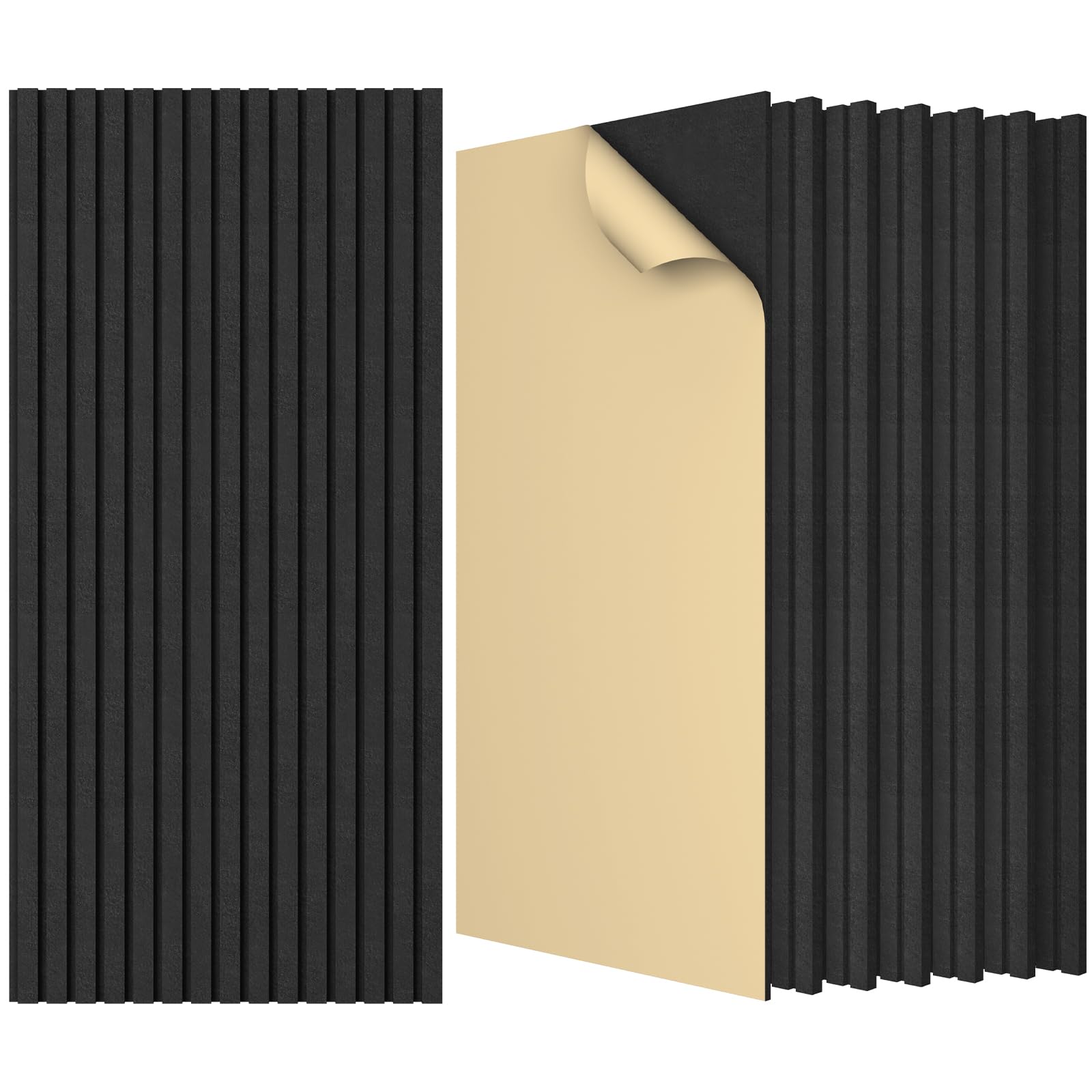
Sixty-one square feet from a single box is what makes this TONOR set the practical answer for a whole wall. Eight panels, each 47.2 by 23.6 by 0.35 inches, with a stated NRC of 0.9 and a peel-and-stick back: one order, one afternoon, and a long wall that no longer rings.

This is the set we reach for when coverage matters more than the last degree of absorption. The polyester fiber is dense at 212.2 kg/m³, denser than the cheap foam tiles it competes with, and the striped face reads as a deliberate design choice rather than something to hide behind a curtain. On the wall behind a sofa or a desk, eight panels take a room from echoey to comfortable in one go, which is simply not true of the single-panel picks here.

Two things to know before it goes up. The backing needs a clean, smooth, painted surface; dust, texture, or fresh paint and a panel can let go, so wipe the wall down and give new paint a few days. And because a stuck panel that comes down usually takes paint with it, mark the layout in pencil first — eight long panels are much easier to place against a line than against each other.

Pros

  • 61 square feet of coverage in one box
  • NRC 0.9 with dense polyester fiber
  • Self-adhesive backing, no hardware to buy
  • Striped face looks intentional on a wall

Cons

  • Thin 0.35-inch profile absorbs little low frequency
Our verdict

We recommend this one when the job is covering a large wall without studio money — 61 square feet arrives in a single box.

Check Latest Price
3

Best Thick Peel-And-Stick

TONOR Dual-Layer Panels

86 /100
Keeper Score Excellent

Key details

Mounting
Self-adhesive
Thickness
0.72 in
Panel Size
47.2 x 23.6 in
Panels Per Pack
4
Check Price on Amazon

Thicker than anything else here that sticks to the wall on its own — 0.72 inches of dual-layer polyester — and that depth is the whole argument for this set. Four panels, each 47.2 by 23.6 inches, with a black felt-like face and a reinforced-corner box that survives shipping better than most.

The extra layer is what makes these worth considering for a bedroom or a living room wall. A thin tile takes the top off a bright, ringing room; a panel this thick starts to work on the lower-middle frequencies that make a TV or a conversation sound muddy. Four panels is a treatment rather than a whole-room fix, and they suit a headboard wall or the space behind a sofa, where a slab of studio foam would look like a mistake.

We noted the ribbed, soft-to-the-touch surface straight out of the box — more furniture than acoustic product — and that's what settles it for us against the thinner TONOR set: same installation, more material, better manners in a room you actually live in. The density that makes them work is also what makes trimming slow, so score deeply and change blades rather than sawing at a panel.

Pros

  • Twice the thickness of typical self-adhesive tiles
  • Reaches lower-middle frequencies, not just the top end
  • Self-adhesive with no hardware
  • Felt-like face suits a living space

Cons

  • Removal can mean patching and repainting
Our verdict

For a bedroom or living room where the panels get looked at as much as listened to, we take this thicker TONOR set.

Check Latest Price
4

Best Wood Slat Panels

NeatiEase Wood Slat Panels

90 /100
Keeper Score Outstanding

Key details

Coverage
33 sq ft
Material
MDF with polyester fiber
Panel Size
96 x 12.6 in
Panels Per Pack
4
Check Price on Amazon

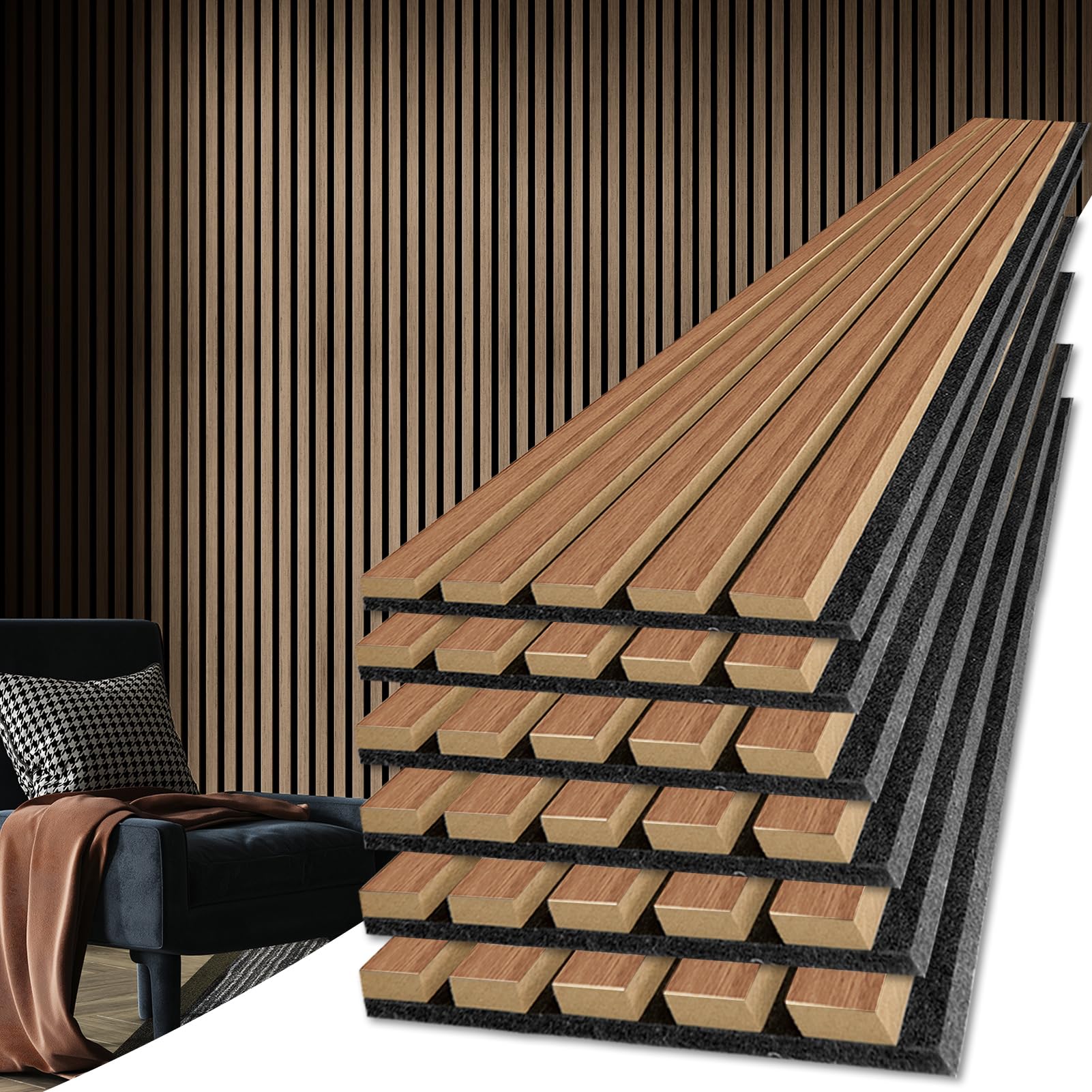
In a room with an eight-foot ceiling, a 96-inch panel runs the full height without a horizontal seam to line up, and that is the detail that makes these NeatiEase boards look installed rather than assembled. Four panels, each 12.6 inches wide, cover about 33 square feet.

They are MDF slats on a polyester fiber backing, so expect a laminate finish rather than solid timber. That is not a knock: the teak veneer carries warmth across a whole wall, and the fiber layer behind the slats is what actually absorbs. Mounted on a home office door or along a music room wall, they take the sharpness out of a room without making it feel padded.

Installation is screws or adhesive, and a circular saw gets through them cleanly, though the cut line is where a laminate shows its seams. Two practical notes from putting these up: lay all four boards out and shuffle them before anything is fixed, because shades can differ within one order, and cut with the blade set shallow so it doesn't tear the fiber backing.

What we keep coming back to is how little these resemble acoustic treatment. The slat face gives a wall shadow and depth, the full-height run avoids the stacked-tile look, and the acoustic benefit arrives as a side effect of something you would hang anyway. Up close you can see the felt between the slats; from across the room it reads as timber, which is the point.

Pros

  • 96-inch boards avoid a horizontal seam
  • 33 square feet across four boards
  • Absorbing fiber backing behind the slats
  • Reads as wood paneling, not acoustic foam

Cons

  • MDF slats with a veneer, not solid wood
Our verdict

Our pick if you want the wall to look like wood: full-height panels that work acoustically and visually at the same time.

Check Latest Price
5

Best Budget Kit

Lebenforce 22-Pack Tiles

88 /100
Keeper Score Excellent

Key details

Coverage
21.27 sq ft
Thickness
0.4 in
Panel Size
12 x 12 in
Panels Per Pack
22
Check Price on Amazon

If you have never treated a room before, the arithmetic is the hard part: how many tiles is enough? This kit answers with 22 of them, covering 21.27 square feet, which is enough for two walls of a home office or the echo-prone corner of a bedroom, and few enough that a miscount costs you a tile rather than a wall. For a first attempt, this is the kit we hand people.

At 0.4 inches they work on the top end of the spectrum: keyboard clatter, a television across the room, the ring of a hard-floored hallway. They won't stop sound leaving the room and they won't touch a bass guitar, so don't expect a drum kit to become neighbor-friendly. Where they earn their keep is a ceiling in a room that echoes, or the wall behind a desk — both easy with a self-adhesive tile that cuts with a knife.

Pros

  • 22 tiles cover 21 square feet
  • Peel-and-stick and easy to cut
  • Works on ceilings as well as walls
  • Budget-tier price for a full kit

Cons

  • Residue is difficult to remove from painted walls
Our verdict

A sensible first kit for a small office or bedroom — 22 tiles, one afternoon, and a real drop in echo.

Check Latest Price
6

Studio Corners

TroyStudio 52-Pack Foam

85 /100
Keeper Score Excellent

Key details

Coverage
52 sq ft
Thickness
2 in
Panel Size
12 x 12 in
Panels Per Pack
52
Check Price on Amazon

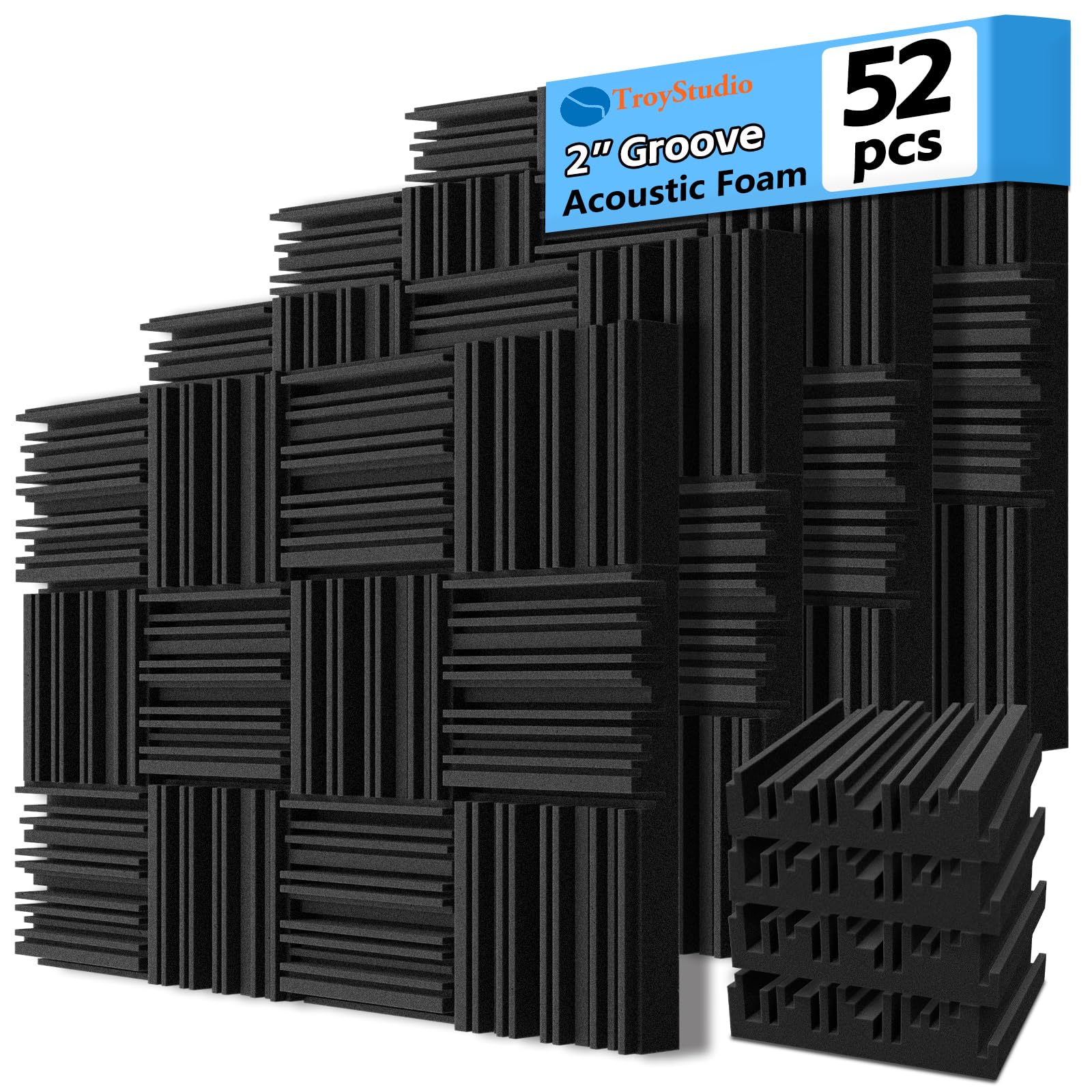
Open-cell foam this thick — two full inches — is a different product from the thin tiles elsewhere on this list. Thickness is what lets foam work below the midrange, and the groove cut across each tile does double duty: it scatters some of what it doesn't absorb and breaks up the flat, dead look of plain foam squares.

Fifty-two tiles is 52 square feet, which works out to the lowest cost per square foot of anything we recommend, and that is the reason it stays on the list. This is studio foam and we mean that literally: it is the right buy for a corner behind a desk, a closet vocal booth, or the wall a drum kit faces, and the wrong buy if your actual problem is a neighbor's bass coming through a shared wall.

It is rated to California Technical Bulletin 117-2013, worth knowing if it is going anywhere near a socket or a heater, and it cuts cleanly with a fresh utility knife — hold a straight edge, score, and snap. Fitting around a vent or a window frame takes minutes rather than a saw.

Pros

  • Two-inch thickness reaches below the midrange
  • 52 square feet per box
  • Flame retardant to CA TB 117-2013
  • Cuts cleanly with a utility knife

Cons

  • Compressed packaging dents some tiles
  • No adhesive or mounting hardware included
Our verdict

The cheapest depth here: two-inch foam for a studio corner, as long as you supply your own adhesive.

Check Latest Price
7

Rooms on Show

Soon Global Art Panels

90 /100
Keeper Score Outstanding

Key details

Coverage
3348 sq in (6 panels)
Mounting
Adhesive stickers included
Assembled Size
72 x 48 in
Panels Per Pack
6
Check Price on Amazon

Six panels go up as a single 72-by-48-inch image, which is the whole idea: a printed panel that happens to absorb sound, rather than an absorber you try to disguise. The face is polyester fiber with an artist's design across it, and the panels hang from the clear double-sided stickers in the box — though on a textured wall, plan on more of them or your own strips.

Acoustically it behaves like a large felt panel: thousands of square inches of absorbing surface in one place, enough to take the ring out of a high-ceilinged bedroom or a hallway with hard floors. It trims easily around an outlet with a utility knife, and the print is what people notice first, before they work out why the room feels calmer.

We like that the panels can go up as two groups rather than one 72-by-48 block — the escape hatch when the wall you had in mind turns out to be narrower than the picture. That flexibility is what turns this from a novelty into something you can actually plan a room around.

Pros

  • Six panels form one 72 x 48 inch image
  • Absorbs echo in tall, hard rooms
  • Cuts easily around outlets
  • Décor first, acoustic treatment second

Cons

  • Print reads softer than the listing photos
Our verdict

We recommend it when the treated wall is one guests actually look at — it does the acoustic job while doubling as the picture.

Check Latest Price
8

Subtle Slat Accent

Art3d 6-Pack Wood Slats

90 /100
Keeper Score Outstanding

Key details

Coverage
31.5 sq ft
Material
MDF with polyester fiber
Panel Size
94.5 x 7.9 in
Panels Per Pack
6
Check Price on Amazon

Narrow slats change a wall's character more than the specs suggest. At 7.9 inches these are the finest boards here, so you get more lines per foot and a surface that reads as paneling rather than as a statement; six of them, each 94.5 inches long, cover about 31.5 square feet.

Installation is straightforward and the cuts are clean — a circular saw goes through them without tearing the laminate, which not every slat panel in this group manages. The veneer is thin at the corners, where small chips are the first thing to show, but they mostly vanish once the pattern is on the wall and you stop looking at any single board.

Acoustically these do what slats do: they take the edge off a reflective room and leave the low end alone. Behind a TV or across a hallway they make a noticeable difference to how bright a space sounds; they are not the answer for a room that needs real bass control. The felt backing is thick and cuts cleanly, and the trimmed edges are sharp, so wear gloves while you handle offcuts.

Where it wins for us is the finish at a distance. The walnut has enough grain variation that it doesn't flatten into a printed pattern, and at 7.9 inches the slats give a wall texture without demanding that the whole room be built around them.

Pros

  • Narrow 7.9-inch slats give finer texture
  • 31.5 square feet across six boards
  • Cuts cleanly with a circular saw
  • Walnut laminate reads as real timber

Cons

  • Costs more per square foot than the felt tiles
Our verdict

Our pick for a subtle slat accent: narrower boards, a convincing walnut finish, and clean cuts with a circular saw.

Check Latest Price

How We Chose and Tested the Best Acoustic Panels

We started with listings and spec sheets, then filtered hard: panels where the thickness and density were actually stated, packs whose coverage could be compared on a price-per-square-foot basis, and materials that matched how each room would be used. A 22-pack of 12-inch squares and a four-pack of 47-inch tiles are not the same purchase, and treating them as one leads to a badly covered wall. That left a dozen sets — adhesive foam squares, thick dual-layer tiles, wood slats, and a printed art panel — spanning budget to splurge.

Testing ran seven months across three spots: the wall behind a desk in a spare bedroom used for video calls, the wall beside a living room TV, and a basement ceiling corner. I mounted each set solo with a level, a pencil line, and a utility knife, and timed how long the first panel took to place.

Adhesion got checked at one week, one month, and three months — I pressed a thumb into every corner to feel for lift, and noted where a textured or recently painted wall caused trouble. For cutting, I scored each panel to see whether foam tore, whether wood slats splintered, and whether the cut edge stayed square enough to butt cleanly against its neighbor. For sound, I clapped and played the same spoken-word clip in each room before and after, listening for how much of the slap came back; thicker, denser panels pulled out noticeably more of the echo, while thin squares mostly tamed the highest frequencies. Finally, I looked at each finished wall in daylight and lamplight for seams, color match, and dust.

How to Choose Acoustic Panels

Absorption Is Not Soundproofing

A panel absorbs the sound that hits it inside the room, which shortens echo and reverb and makes speech and music easier to follow. It does almost nothing about noise traveling through a wall, a floor, or a closed door, because that is a mass-and-sealing problem rather than an absorption one. If your complaint is a neighbor's television, spend the money on sealing gaps and adding mass. If your complaint is that your own room booms on every call, panels are the right tool — every pick here is in that second category.

Thickness and Core Decide What Gets Absorbed

Thin is not useless. A 0.35- or 0.4-inch polyester tile takes the brightness off a reflective room, and a wall of them does change how a home office sounds. But thickness buys low-frequency control: two inches of mineral wool or open-cell foam reaches down into the range that makes voices sound chesty and small rooms sound boxy. If you're treating a corner, a drum kit, or a room where the TV booms, buy depth.

The core matters as much as the number. A rigid mineral wool panel in a wood frame is the most efficient absorber per square foot in this group; dense polyester is next; foam gives you depth for very little money but less control. Grooved and beveled faces scatter a little of what they don't absorb, which is why they don't look or sound quite as flat as a plain block.

How Panels Go Up, and How They Come Down

Peel-and-stick is the whole appeal of felt and polyester tiles, and it works well on smooth, clean, painted drywall. It works badly on textured plaster, brick, or a wall that was painted last week. The trap sits in the phrase damage-free: adhesive that has been up for a year often takes a layer of paint with it, so press a spare tile into a hidden corner first and see what happens when you peel it off. Rigid panels with wood frames are a different job entirely — those want screws, anchors, and the supplied hardware.

Coverage and Placement

One box rarely treats a room. Aim to cover roughly 20 to 30 percent of a wall surface, spread across the places sound actually hits: the wall behind your chair, the first reflection points to either side, and a corner if bass is the problem. A cluster in one spot does less than the same panels spread out. Two panels behind a desk beat six stacked in a corner, and a tile above a mix position often does more than another square of wall at knee height.

What Wood Slat Panels Buy You

Slat panels are a real absorber, but the slat face reflects more high frequency than a flat fabric-wrapped panel, so their effect is gentler and more decorative than the numbers suggest. What they buy is a wall you would hang anyway: 94- to 96-inch boards run floor to ceiling without a horizontal seam, and the felt backing behind the slats does the acoustic work. Expect an MDF core with a veneer rather than solid timber, and plan the layout around outlets before the first screw goes in.

Frequently Asked Questions

Final Verdict

The ATS panel is the one we point to first, because it is the only pick here built like a genuine absorber: mineral wool in a wood frame, backed by the top absorption rating in the group. It costs more per square foot and it asks for a drill, and neither matters if your room actually has to sound different on a recording.

If the job is covering a wall rather than solving one spot, the TONOR eight-pack gets you 61 square feet for far less per square foot, and the dual-layer set is the better-mannered version for a bedroom. If the wall is on show, buy the NeatiEase boards and treat the acoustic improvement as a bonus.